
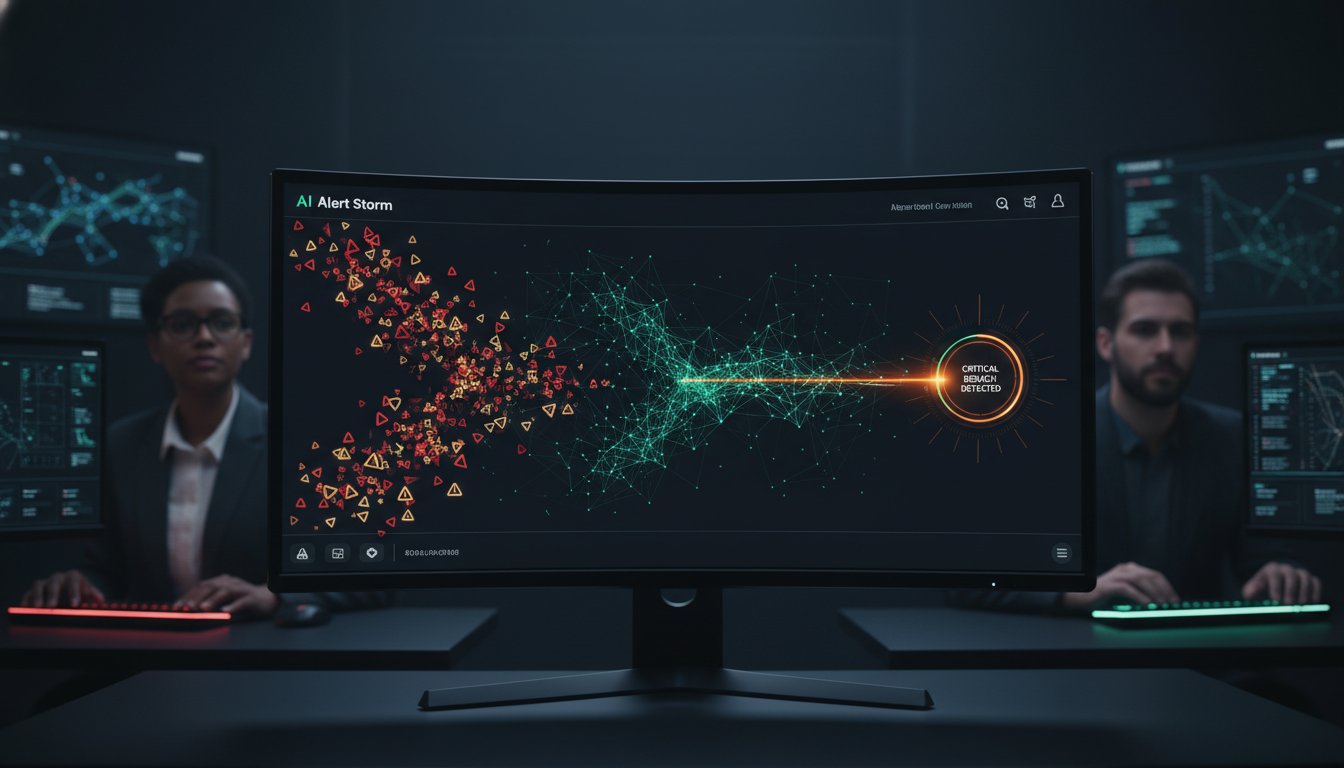
Recent industry reports indicate that 8% of organizations lose more than $1 million per hour during IT downtime. If you're an SRE or DevOps engineer, you've likely felt that pressure while manually drafting status updates or digging through fragmented logs at 3 AM. It's a stressful, high-stakes environment where traditional tools often fail to scale. AI incident management isn't about replacing your expertise with a "black box" algorithm. It's about using machine learning to filter out the noise and handle the repetitive tasks that slow down your response loop.
AI incident management is the application of machine learning and generative AI to automate alert correlation, root cause identification, and stakeholder communication during a technical outage. By integrating these tools, teams can reduce their mean time to resolution (MTTR) while maintaining human oversight. We know that alert fatigue and manual reporting are the primary bottlenecks in your current workflow. This guide will show you how to integrate AI into your response loop to identify root causes faster and automate customer communication. You'll learn to build a predictable, efficient system that respects your time and your budget.
Key Takeaways
- Learn why manual incident logging fails as microservices scale and how automated correlation reduces alert fatigue.
- Distinguish between predictive AIOps for server monitoring and generative AI for drafting impact summaries.
- Build an effective ai incident management loop by centralizing monitoring data and defining trigger thresholds for automation.
- Prioritize data sovereignty and transparent pricing by choosing tools with EU-based hosting and no per-subscriber fees.
- Reduce communication lag by using AI to draft status updates while maintaining accuracy through human oversight.
The Scaling Problem: Why Traditional Incident Management is No Longer Sufficient
Traditional incident management is reaching its breaking point. As teams move from monolithic architectures to hundreds of microservices, the volume of telemetry data has exploded. This complexity creates a persistent state of alert fatigue. Engineers are often buried under a mountain of non-critical notifications. It's difficult to spot the signal in the noise. This is where AIOps becomes essential. It provides the algorithmic foundation needed to correlate these disparate signals into a single, actionable incident.
The hidden cost of this complexity is context switching. Manual incident logging requires an engineer to stop their technical investigation to document findings. Every time an SRE jumps from a terminal to a browser, they lose technical focus. This friction directly impacts the speed of resolution. Effective ai incident management aims to remove these manual hurdles by automating the administrative side of the response loop. It allows the team to stay in the zone while the system handles the paperwork.
The MTTR Bottleneck in Modern Stacks
Mean Time to Recovery (MTTR) is often hampered by fragmented data. When an outage occurs, logs are scattered across multiple platforms. SREs face a high cognitive load as they search through disparate monitoring tools to find the root cause. Fragmented observability stacks mean that an engineer might start in Grafana, jump to a log aggregator, and finish in a cloud console. Each transition adds seconds or minutes of delay. In high-pressure environments, these delays compound. There's also a significant time gap between identifying an issue and updating stakeholders. Without automation, the "issue identified" phase can drag on while the status page remains stagnant.
The Communication Gap During Outages
During a crisis, engineers are often the worst choice for writing public-facing updates. Their focus is on the technical resolution, not on managing customer expectations. This leads to "radio silence," which is a primary driver of customer churn and lost trust. There is a constant trade-off between speed and technical accuracy. If an update is too vague, it's useless. If it's too technical, it confuses the user. Ai incident management addresses this by drafting precise summaries based on technical logs. This allows the engineer to review and approve an update in seconds rather than spending ten minutes drafting one from scratch. It bridges the gap between the server room and the customer dashboard. Platforms like StatusPulse AI handle this by combining uptime monitoring with automated drafting, ensuring that stakeholders stay informed without distracting the on-call team.
Decoding AI Incident Management: AIOps vs. Generative AI
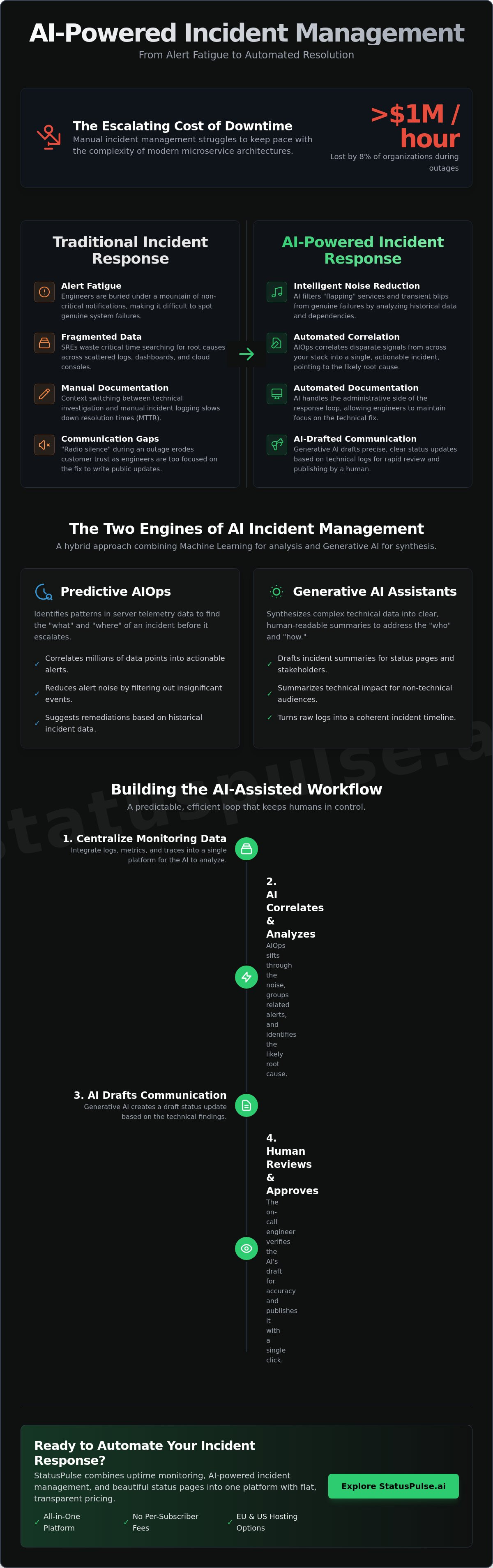
Effective ai incident management is not a single technology. It is a hybrid approach that combines Machine Learning (ML) for pattern recognition with Large Language Models (LLMs) for data synthesis. ML handles the "what" and "where" by categorizing millions of telemetry points. LLMs handle the "who" and "how" by summarizing the impact for human stakeholders. This distinction is vital for building a functional AI-assisted incident workflow that actually saves time.
Predictive AIOps focuses on identifying subtle patterns in server uptime monitoring data before a hard failure occurs. By using vector search, modern systems can retrieve historical incident data that shares similar telemetry profiles. This allows the system to suggest remediations based on what worked during previous outages. It turns your historical logs into an active knowledge base rather than a static archive.
Predictive Analysis and Alert Noise Reduction
Alert noise often stems from "flapping" services that trigger and resolve within seconds. AI filters these transient blips from genuine system failures by analyzing historical frequency and downstream dependencies. In the context of api monitoring, alert correlation means grouping multiple failed endpoint calls into a single incident based on shared infrastructure or upstream service health. Training local models on your own historical data is more effective than relying on generic industry benchmarks. It ensures the AI understands your specific architectural quirks and baseline performance levels.
Generative Assistants for Incident Coordination
Generative AI excels at the administrative transitions that usually slow down SRE teams. It can scan internal Slack threads or incident channels to extract a chronological timeline of events. This timeline then becomes the basis for a public status update or a Root Cause Analysis (RCA) document. Summarizing technical logs into plain English is another high-value task for generative models. It saves hours of post-incident work by drafting the first version of an RCA for human review. If you want to automate these summaries without losing control, exploring an AI-driven incident management platform can help bridge the gap between technical data and human communication.
How to Build an AI-Assisted Incident Workflow
Building an ai incident management system shouldn't be a multi-month enterprise project. It requires a logical progression from data collection to human-verified automation. Start by centralizing your telemetry through OpenTelemetry or similar standards. Without a unified view of your logs and metrics, AI models lack the context to distinguish between a transient error and a cascading failure. You can't automate what you can't see.
Once your data is centralized, you can implement a structured five-step workflow:
- Centralize: Connect your APM, log aggregators, and error tracking to a single hub.
- Thresholds: Define what constitutes an "incident" versus a "warning" to prevent noise.
- Drafting: Enable AI to generate internal timelines as soon as a high-severity threshold is met.
- Verification: Implement a mandatory review step for all public-facing content.
- Iteration: Use post-mortem feedback to tune your prompt library and model accuracy.
This approach moves the burden of documentation away from the engineer. It allows the on-call team to focus on the technical resolution while the system prepares the necessary reports. It's a pragmatic way to scale without adding headcount.
Configuring Triggers and Alert Thresholds
Not every alert deserves an automated summary. Differentiating between a minor latency spike and a critical outage is essential to prevent "AI noise." You should only trigger ai incident management workflows when high-severity conditions are met. For example, you might set a trigger for when a 5xx error rate exceeds 5% for more than two minutes. This is especially true when uptime monitoring fails across multiple regions simultaneously. By setting these strict thresholds, you ensure that your team only sees AI-generated drafts during genuine crises.
Human-in-the-Loop: Maintaining Technical Integrity
Technical integrity is non-negotiable. You must never allow AI to post directly to a public status page without a human check. Models can sometimes hallucinate technical details or use incorrect terminology that confuses customers. A reliable workflow follows a strict sequence: AI drafts, an on-call engineer edits for accuracy, and an admin publishes. This keeps the speed of automation while ensuring a human has the final word. It also helps maintain a consistent brand voice. A small, principled team can manage large-scale outages effectively by using StatusPulse AI as a coordination assistant rather than an autonomous actor. This keeps your communication honest and your technical data accurate.
Evaluating AI Incident Tools: Performance, Privacy, and Cost
Selecting an ai incident management tool requires a cold analysis of how it handles your telemetry. You need a system that integrates with your current stack through open standards like OpenTelemetry. Proprietary agents often create vendor lock-in and increase the complexity of your deployment. If a tool struggles with your specific technical jargon or custom error codes, it poses a significant hallucination risk. An AI that misinterprets a 504 Gateway Timeout as a database syntax error will only slow down your recovery process. You don't want to spend your time correcting the AI while the system is down.
Performance isn't just about speed; it's about the precision of the context provided to the model. High-quality tools use vector search to pull relevant historical data. This allows the AI to suggest remediations based on what actually worked in your environment six months ago. Without this historical grounding, the AI's suggestions are just generic guesses. You need a tool that acts as a specialized assistant for your specific architecture rather than a generic chatbot.
Privacy and the GDPR Question
Most AI-driven tools default to US-based processing. For European teams, this often creates a conflict with internal data sovereignty policies. Sending sensitive system logs across borders can trigger complex legal reviews. You should identify tools that offer robust data masking for sensitive logs. This ensures that PII or internal credentials are scrubbed before they ever reach an LLM. StatusPulse allows you to choose between EU or US hosting for your entire stack. This flexibility is essential for maintaining GDPR compliance without sacrificing the speed of AI automation.
Transparent Pricing vs. Corporate Bloat
Legacy incident management platforms often hide their true cost behind per-user or per-subscriber seat models. These models are designed for corporate bloat rather than technical efficiency. Per-subscriber fees are particularly frustrating because they act as a tax on your company's growth. If your user base doubles, your incident management costs shouldn't double with it. During a major outage, per-notification fees can also lead to unpredictable billing spikes that are hard to justify to leadership.
Technical teams usually prefer a predictable, flat-rate model that covers the entire stack. This eliminates the financial friction of adding new team members or scaling your monitoring endpoints. It allows you to focus on uptime rather than seat counts. If you're tired of complex enterprise billing and variable fees, you can explore transparent pricing for ai incident management that scales with your infrastructure, not your headcount.
Efficient Incident Communication with StatusPulse AI
StatusPulse AI functions as a bridge between your technical telemetry and your human stakeholders. It isn't a separate tool you have to log into during a crisis. Instead, it's baked into the monitoring loop. By integrating ai incident management directly with your uptime checks, the platform identifies failures and prepares the necessary communication simultaneously. This eliminates the frantic search for templates while your services are down.
Pricing remains a major friction point with legacy providers. StatusPulse uses a flat pricing model that scales with your infrastructure rather than your team size. You won't face per-subscriber fees or "taxed" growth when your user base expands. You also have the choice between EU or US hosting to meet your specific data sovereignty requirements. It's a straightforward approach built for teams that value precision over corporate bloat.
From Alert to Update in Seconds
StatusPulse AI analyzes the specific error codes and latency spikes gathered by its monitoring agents to suggest accurate wording for your updates. If a specific API endpoint returns a 503 Service Unavailable, the AI identifies the impact and drafts a summary. This reduces the time spent on manual drafting during the most critical minutes of an outage. The "draft and review" interface ensures that an engineer always checks the technical details before anything goes live. You maintain absolute control over the final message while the AI handles the heavy lifting of composition.
Building Long-Term Trust
Honest and transparent communication is the most effective way to prevent customer churn. When a system fails, users don't just want it fixed; they want to know you're aware and working on it. AI helps maintain a professional, calm tone even when the on-call team is under high stress. While many website uptime monitoring tools focus solely on the "down" signal, StatusPulse pairs that signal with clear communication. This integrated approach builds long-term trust by removing the "black box" of technical disruptions. If you're ready to automate your response loop without losing technical integrity, you can start using StatusPulse AI to manage your next incident with precision.
Modernizing Your Incident Response Loop
Traditional incident response is no longer fast enough for the complexity of modern microservices. By implementing ai incident management, you remove the administrative friction that prevents SREs from focusing on technical resolution. It's about augmenting human expertise, not replacing it. A successful workflow requires a human-in-the-loop to verify technical accuracy and maintain stakeholder trust. Your choice of tools should reflect these technical and ethical priorities. Prioritize platforms that offer data sovereignty through a choice of EU or US hosting. Avoid the trap of per-subscriber fees that penalize your company for growing its user base.
StatusPulse provides a straightforward, all-in-one platform that combines uptime monitoring with AI-powered incident drafting. It helps you move from alert to public update in seconds while keeping your data where you want it. You get flat-rate pricing that remains predictable regardless of how many subscribers you have. Start monitoring with StatusPulse for free to streamline your next response. You've built a resilient system; it's time your incident management reflected that level of precision.
Frequently Asked Questions
What is AI incident management and how does it differ from traditional monitoring?
AI incident management uses machine learning to correlate disparate alerts and generative AI to summarize their impact. Traditional monitoring simply reports state changes based on fixed thresholds. This modern approach moves beyond basic "up or down" signals to provide contextual understanding. It helps identify complex patterns across fragmented logs that are difficult for humans to spot during a high-pressure outage.
Can AI actually resolve technical issues automatically?
No, current AI tools primarily assist with coordination, diagnosis, and communication rather than autonomous code fixes. While some systems suggest remediations based on historical data, the actual resolution still requires human intervention. AI acts as a specialized assistant that speeds up the investigation phase. It is not a replacement for an SRE's technical judgment or manual troubleshooting.
Is it safe to send my system logs to an AI for incident summarization?
Safety depends on the tool's data masking capabilities and hosting location. You should prioritize platforms that scrub personally identifiable information and credentials before data reaches a Large Language Model. Using a provider that offers a choice between EU or US hosting can also mitigate risks associated with cross-border data transfers. Always verify the vendor's privacy standards before integrating sensitive telemetry.
How does AI help reduce Mean Time to Recovery (MTTR)?
AI reduces MTTR by accelerating root cause identification and stakeholder communication. By automatically correlating related alerts into a single incident, it prevents engineers from wasting time on redundant notifications. It also handles the drafting of status updates. This allows the technical team to stay focused on fixing the underlying infrastructure issue rather than managing manual documentation tasks.
Do I need a large data science team to implement AI incident management?
No, modern SaaS platforms provide pre-trained models that work out of the box with standard telemetry like OpenTelemetry. Most teams only need to connect their existing monitoring integrations and define their severity thresholds. You don't need to build custom models from scratch to see immediate benefits in alert noise reduction and automated reporting. It's designed for specialists to use immediately.
What are the privacy implications of using AI incident tools in the EU?
EU-based teams must ensure their tools comply with GDPR, particularly regarding where data is processed and stored. Choosing a tool with EU-based hosting helps maintain data sovereignty and simplifies legal compliance. It's also important to verify that the AI vendor doesn't use your sensitive system logs to train their public models. Transparency in data handling is a core requirement for European operations.
Can AI incident management help reduce alert fatigue for my SRE team?
Yes, ai incident management reduces alert fatigue by filtering out transient "flapping" services and correlating hundreds of individual alerts into manageable incidents. This ensures that engineers only receive notifications for genuine, high-priority failures. By reducing the volume of non-actionable noise, teams can maintain better focus and experience less burnout during their on-call rotations.
How do I ensure AI-generated status updates are technically accurate?
You should integrate a mandatory review process where an engineer must approve every draft before it goes public. AI should be treated as a drafting assistant that pulls facts from technical logs, but a human must verify the final context. This workflow maintains the speed of automation while preventing hallucinations or technical inaccuracies from reaching your customers through the status page.


