

A ping notification is not an incident response plan. Uptime monitoring alerts help only when they detect a meaningful service problem, reach someone who can act, and provide enough context to begin an investigation. A check can miss an outage between runs, while a healthy homepage can hide a failing API or an expired certificate.
False alarms create the opposite risk: when notifications arrive too often, responders may start ignoring them. The answer is not to alert on every failed request or send every notification to everyone. Define what counts as an incident, confirm failures where appropriate, and assign clear ownership and escalation paths.
This guide explains how to tune alert conditions, monitor websites, APIs, and SSL certificates, and route notifications to the right responder. It also covers how to connect detection with incident updates, so teams can act on real availability problems and keep users informed without adding noise.
Key Takeaways
- Define what a failed check means for each endpoint, and distinguish availability from latency, API correctness, and user-journey health.
- Build uptime monitoring alerts around clear failure conditions, confirmation logic, and a named owner. Account for the delay stricter confirmation can add.
- Separate isolated failures, repeated failures, and sustained degradation so each pattern gets an appropriate response.
- Document who receives alerts, what acknowledgement means, and how responders confirm recovery before closing an incident.
- Treat alerts as investigation signals, then share confirmed impact and progress with customers through a public status page.
What Uptime Monitoring Alerts Detect, and What They Cannot Tell You
A monitoring check tests a service against a defined condition. An alert is the notification triggered when the result meets that condition. For example, a check requests a website and evaluates its response; an alert tells an owner that the expected result was not received. Well-configured uptime monitoring alerts identify specific availability problems, but they do not explain every cause or reveal the full user impact.
Website monitoring can measure availability and response time in different ways. Decide which service behavior each check represents, and avoid treating one successful response as proof that the whole application works.
Which failures should an uptime alert detect?
Start with critical, user-facing endpoints. A check might verify that a public page is reachable and returns an expected HTTP status, or request an API endpoint and validate its response. SSL certificate monitoring can flag certificate validity problems that may prevent secure connections.
Choose checks based on what users need to access, not just what is easy to ping. One endpoint can confirm that a single route responds, but it cannot represent every dependency, feature, or workflow. A healthy landing page, for instance, does not prove that sign-in or checkout works.
Why can a service look up while users still experience problems?
Availability is only one signal. A service may return a successful response while taking too long to load, failing to retrieve data, or breaking a function used by only some customers. An API can be reachable but return incomplete or incorrect results. These are partial failures, not necessarily a full outage.
Basic uptime checks answer a narrow question: did this endpoint meet its configured condition? Application observability adds detail from signals such as metrics, logs, and traces to help investigate where and why behavior is degrading. Use endpoint checks to detect externally visible failures, then use application telemetry when diagnosis requires more context.
For broader context on planning checks across services, consider the uptime monitoring platform alongside your application’s own telemetry. A check reports what it observed, not the root cause or the complete user experience.
How an Uptime Alert Moves from a Failed Check to an Incident
Detection identifies a condition that needs attention. Incident response is the human-led work of assessing impact, coordinating a fix, and confirming recovery. A failed check should start a clear workflow, not declare a root cause.
The workflow is straightforward: run the check, evaluate its result against configured conditions, notify the responsible person, triage the signal, respond, and verify recovery. Each step answers a different question. Did the check fail? Does that failure meet the alert rule? Who needs to investigate? Is the service working again?
Confirmation logic can filter an isolated network blip. For example, a team might require repeated failures before notifying an on-call responder. That reduces reactions to transient errors but adds detection delay. Set the rule according to the service’s impact and tolerance for delayed notification, and ensure sustained failures still reach someone promptly.
What should an actionable uptime alert contain?
Give responders facts they can use immediately: the affected service or endpoint, the observed symptom, and when the check recorded it. “Payments API returned an unexpected response at 14:32 UTC” is more useful than “Service down.” Include a runbook link or a concrete first step if the team maintains one.
Keep observations separate from hypotheses. A failed request confirms what the check observed; it does not prove that a database, deployment, or network issue caused it. This distinction helps responders investigate without anchoring on an unverified explanation.
How should teams route and acknowledge alerts?
Assign ownership before an incident. Document the initial responder for each critical service, how they acknowledge an alert, and what happens if it remains unacknowledged. Escalation should be a defined fallback, such as notifying the next responsible role, not an assumption that someone else is watching.
API checks also need service context. A failed health endpoint and an API operation returning incorrect data may require different investigation paths. Repeated notifications without clear ownership can contribute to alert fatigue, a problem the Agency for Healthcare Research and Quality describes in a healthcare setting. The practical lesson applies here too: make alerts relevant, actionable, and directed to someone responsible.
Teams bringing endpoint checks, API monitoring, and incident follow-up into one workflow can use StatusPulse monitoring and incident management to connect those parts.
How to Reduce Uptime Alert Fatigue Without Hiding Real Failures
Useful alerting distinguishes a momentary blip from a failure that needs action. Tune conditions to the endpoint’s importance, the impact of failure, and how quickly the team needs to respond. No single threshold or check interval suits every service.
| Observed pattern | Possible interpretation | Alerting approach |
|---|---|---|
| One isolated failure | A transient error or brief connectivity issue | Use confirmation if the endpoint’s impact allows the added delay. |
| Repeated failures | A likely availability problem that persists across checks | Notify the responsible owner when the configured condition is met. |
| Sustained degradation | The service responds, but performance remains outside an acceptable range | Define a separate condition if the monitoring setup measures that signal. |
When should a failed check trigger an alert?
Base the rule on what the endpoint does. A failure on a critical sign-in or payment route may warrant faster notification than a problem on a low-impact page. Consider the consequences of a missed failure alongside the cost of waking someone for a transient one.
If your monitoring setup supports confirmation across multiple checks or locations, use it to distinguish a local probe issue from broader unavailability. Confirmation can reduce noise, but it can also delay notification. Test rules against observed service behavior instead of copying a threshold from another system.
How can teams keep alerts useful over time?
After incidents, review false positives, missed failures, duplicate notifications, and alerts that had no clear owner. Adjust conditions or routing based on what happened. Keep the original incident visible when suppressing duplicates: deduplication should reduce repeated noise, not hide a continuing outage.
Where the tooling supports it, treat a new incident, an ongoing incident, and recovery as distinct states. That gives responders a clear signal when service health changes without repeatedly notifying them about the same failure. For larger incidents, role-based coordination such as the Incident Command System (ICS) can help clarify who directs the response and who communicates updates.
Alert rules are part of the monitoring design, not permanent settings. Review them as services change, and use a broader guide to uptime monitoring tools when assessing how your setup supports checks, routing, and incident follow-up.
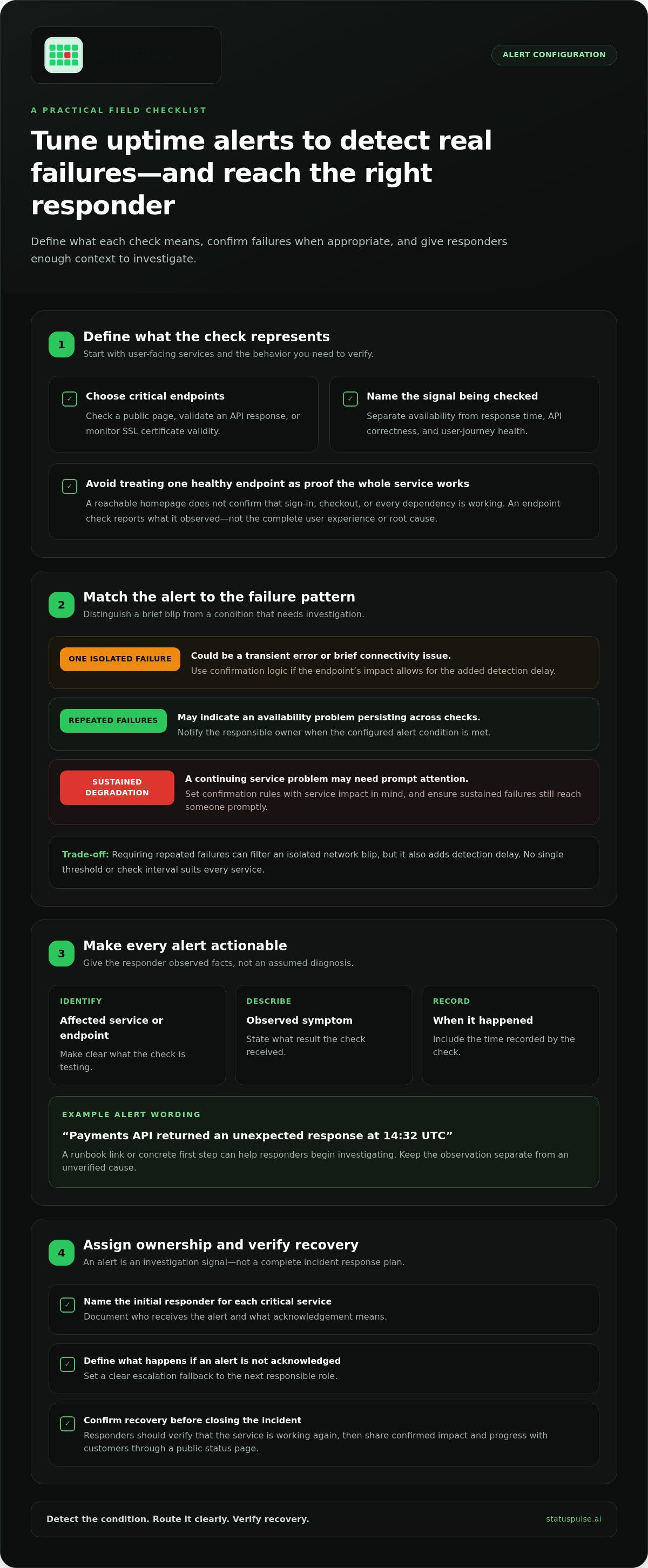
A Practical Checklist for Configuring Uptime Monitoring Alerts
Reliable configuration starts with a service inventory, not a notification channel. List the public endpoints and APIs users depend on, record the expected response for each, and assign an owner who can investigate failures. Include dependencies and user-visible failure modes where they affect the service, but do not assume one endpoint check covers an entire workflow.
What should an uptime alert rollout include?
For every check, decide what constitutes failure, who receives the notification, how they acknowledge it, and what happens if they are unavailable. Set recovery handling too: responders should know what evidence is enough to mark the service healthy again. Then test the complete path, from a controlled failure through notification, acknowledgement, investigation, and recovery.
- Endpoint: Name the critical public route or API operation.
- Expected behavior: Record the expected status, response content, or other check condition.
- Owner and fallback: Identify the initial responder and escalation path.
- Incident handling: Define acknowledgement expectations and recovery criteria.
- Test: Simulate a failure and verify each step reaches the right person.
This configuration-neutral record gives teams a shared reference without tying the process to a specific monitoring tool or syntax. Revisit it when endpoint behavior, service ownership, or dependencies change.
How should teams handle SSL and API alerts?
Track certificate validity separately from endpoint reachability. A website can respond to a check while a certificate problem still prevents some users from establishing a trusted connection. Treat certificate state as its own signal, with an owner and a clear response path.
For APIs, check more than whether a host responds. Where appropriate, validate the expected HTTP status or response content so an endpoint returning an error payload does not appear healthy. Keep checks aligned with the operation’s purpose, and avoid placing sensitive data in test requests or alert details.
Once checks and ownership are defined, configure uptime monitoring and incident handling around that workflow. Test notifications deliberately, document how responders confirm recovery, and refine the setup as the service evolves.
Connect Uptime Monitoring Alerts to Clear Incident Communication
An uptime alert is a signal to investigate, not proof of a specific root cause. A failed check may show that an endpoint returned an unexpected response, but it does not establish whether a deployment, network issue, or dependency caused the failure. Keep internal diagnosis separate from customer-facing claims until the impact is understood.
Once the team confirms that customers are affected, use a public status page to share what is known and what happens next. A useful update identifies the affected service, describes the confirmed impact in plain language, and includes when the information was last updated. If the cause or recovery time is still unknown, say so. Clear uncertainty is more trustworthy than a confident guess.
When should an internal alert become a customer update?
Do not publish every failed check automatically. First assess whether it represents a real issue and whether users are affected. Internal responders may discuss possible causes during triage; public updates should stick to confirmed impact, investigation progress, and changes in service status. This keeps communication transparent without presenting early hypotheses as facts.
Define who reviews and publishes updates, and how the team will keep them current. An incident communication architecture should connect monitoring signals, response ownership, and customer updates while keeping a human responsible for what gets published.
How can monitoring and communication work together?
Think of the workflow as connected stages: monitoring detects a condition, responders investigate, and a status page communicates verified impact and progress. AI-assisted incident management can help draft or summarize an update, but a person should review it for accuracy before publication. The tool can reduce writing overhead; it should not make the final call about what customers are told.
StatusPulse brings uptime, API, and SSL certificate monitoring together with public status pages and AI-assisted incident management. The cloud-based platform is based in the EU. Assess hosting and data-location requirements in the context of your own needs.
Explore StatusPulse monitoring and status-page capabilities to see how detection and customer communication can fit into one incident workflow.
Make Every Alert Lead to Clear Action
Reliable uptime monitoring alerts do more than report a failed check. They apply conditions that reflect service impact, reach a clear owner, and give responders useful facts without claiming an unverified cause. Review alert outcomes after incidents, then tune the rules to reduce noise without hiding a continuing failure.
Detection is only one part of the workflow. Pair monitoring with a human-led response and a public status page that shares confirmed impact and progress with customers. AI can assist with drafting or summarizing updates, while people remain responsible for what gets published.
StatusPulse brings monitoring, public status pages, and AI incident management together in one platform. Explore StatusPulse uptime monitoring and incident communication to see how detection and customer updates can work together. Clear ownership and honest communication make incidents easier to manage, one alert at a time.
Frequently Asked Questions
What are uptime monitoring alerts?
Uptime monitoring alerts notify a responder when a monitored service meets configured failure conditions. A check records whether an endpoint behaved as expected; an alert reports a result that needs attention. It does not identify the root cause or establish the full customer impact.
How do uptime monitoring alerts work?
A monitoring system checks an endpoint, compares the result with configured conditions, then notifies the assigned responder if those conditions are met. The responder investigates, addresses the issue, and verifies recovery. Confirmation rules can filter isolated failures, but may delay notification.
How often should uptime monitoring checks run?
Set check frequency based on endpoint importance, outage impact, and how quickly responders need to know. There is no universal interval. Consider frequency alongside confirmation rules, since both affect detection time and alert noise.
Why am I getting false uptime alerts?
Transient network errors, incorrect expected responses, or monitoring-location issues can trigger false alerts. Review the check result and confirm that its conditions match the endpoint’s intended behavior. If supported, confirmation logic can filter isolated failures, though it may add delay.
What should an uptime alert include?
Include the affected service or endpoint, the observed failure condition, and the time detected. Add a runbook or first step if available, along with a clear owner. Keep facts separate from suspected causes so responders can investigate without treating a hypothesis as confirmed.
Can uptime monitoring detect API and SSL certificate failures?
Yes, if checks cover those signals. API monitoring can test availability and expected response status or content. SSL certificate monitoring tracks certificate validity separately from endpoint reachability. These checks reveal distinct failure modes, so a responding website alone does not confirm that its API or certificate is healthy.
What is the difference between an uptime alert and an incident notification?
An uptime alert reports that a check met a failure condition. An incident notification communicates response status or confirmed customer impact. Treat the alert as an investigation trigger, not proof of a cause. Share public updates only after confirming what users are experiencing.


