
Over €1.2 billion in GDPR fines were issued in 2025 alone. This figure proves that regulators are accelerating enforcement; they're no longer giving passes for "simple" notification lists. You probably worry that adding extra steps to your status page will kill your conversion rates. It's a common fear. Managing complex consent logs while trying to maintain high deliverability for incident alerts is a difficult balance that many teams struggle to get right.
We believe privacy is a core virtue, not a marketing afterthought. You can implement Subscriber Double-Opt-In: Avoiding the GDPR Trap in Status Page Notifications to satisfy strict auditors without sacrificing growth. This guide shows you how to build a compliant notification system that stays audit-ready. We'll examine the shift toward regulating unlawful processing and provide a clear path to securing your incident communications with a framework built for specialists who value precision.
Key Takeaways
- Define the specific risks of mislabeling status alerts and why the "legitimate interest" defense is failing under 2026 regulatory standards.
- Master the technical mechanics of verification triggers and confirmation events to keep your subscriber list clean and audit-ready.
- Understand the deliverability benefits of Subscriber Double-Opt-In: Avoiding the GDPR Trap in Status Page Notifications and how it protects your sender reputation.
- Create a high-conversion confirmation email that encourages immediate action without adding unnecessary friction for your users.
- Leverage native GDPR compliance through EU-based hosting and automated consent trails to satisfy even the strictest data privacy auditors.
The GDPR Trap: Why Status Page Notifications Are High-Risk in 2026
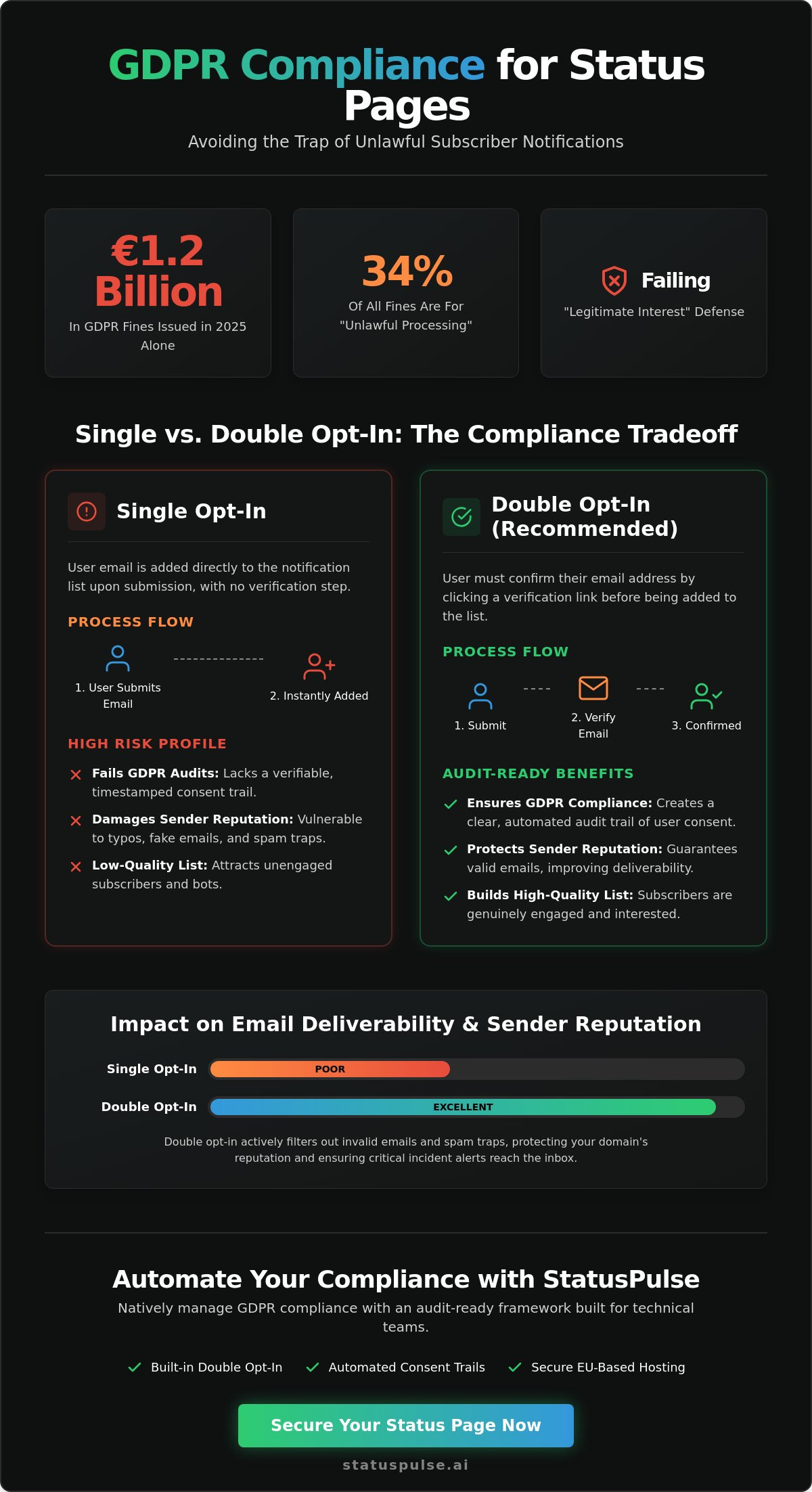
Regulators issued approximately €1.2 billion in GDPR fines during 2025. This surge proves that data protection authorities are no longer focused solely on social media giants. They're looking at how every business handles automated communication. Many DevOps and Product teams are currently walking into a "GDPR Trap." This happens when you mislabel status alerts as purely transactional to bypass consent requirements. In 2026, this shortcut is a liability. You can't just assume a user wants incident pings because they have an account. Privacy standards now demand a clear, documented path of intent.
The "legitimate interest" argument is failing for SaaS status pages. Relying on this vague legal basis is risky. Regulators now prioritize the user's right to control their inbox over a company's desire to send "critical" updates. If your notification system lacks a robust subscriber double opt-in framework, you're likely processing data unlawfully. Statistics show that unlawful processing accounts for 34% of the total value of all GDPR fines. It's the most common reason for penalties today. Implementing Subscriber Double-Opt-In: Avoiding the GDPR Trap in Status Page Notifications is the only way to ensure your incident communications survive a 2026 audit.
Transactional vs. Marketing: The Gray Area of Status Alerts
Status updates often contain "stealth marketing" signals that trigger regulatory red flags. Does your incident email include a link to your latest feature release? Do you have an "Upgrade to Pro" button in the footer of your status page? These elements invalidate the transactional status of the message. If the content isn't strictly limited to the technical resolution of an incident, it's marketing. EU case law is increasingly strict about this distinction. Mixing promotional links with service alerts without explicit consent is a fast track to a heavy fine.
The Legal Reality of Data Storage and Processing
Consent isn't just a checkbox; it's a data processing event. Your status page subscribers require a separate consent record from your main application's database. You must be able to prove when, where, and how a user agreed to receive alerts. In a GDPR audit, the burden of proof rests entirely on the sender. If you can't produce a timestamped log of a confirmed opt-in, you don't have consent. This is why automated trails are essential. Specialist tools like StatusPulse help technical teams manage these records without the manual overhead of traditional enterprise bloat. We prioritize these core virtues because compliance shouldn't be a technical burden.
The Mechanics of Subscriber Double Opt-In for Ops Teams
The technical workflow for a secure status page subscription follows a logical three-step cycle. First, the user submits their email via your sign-up form. Second, your system fires an immediate verification trigger. Finally, the user completes the confirmation event by clicking a secure link. This cycle ensures you meet UK GDPR consent requirements by creating a verifiable audit trail of intent. It's not just about legal compliance; it's about maintaining a clean, high-quality subscriber list.
Integrating this into an uptime monitoring service workflow prevents accidental spamming during high-stress outages. You don't want to alert someone who didn't actually sign up. Handling edge cases like duplicate attempts is straightforward. If an email is already active, the system should ignore the request. If it's pending, resend the verification. This keeps your database lean and avoids confusing your users with redundant emails. Securing these links against bots is also critical. Use hidden honeypot fields in your sign-up form to catch automated scripts. This prevents your status page from being used as a spam relay.
The Verification Trigger: Timing and Delivery
Speed is everything for this trigger. The confirmation email must land in the inbox within seconds of the request. If it takes five minutes, the user has likely moved on. Use a clear "From" address and a direct subject line like "Confirm your subscription to [Service] Status." The technical TTL for a verification token should typically be set to 24 hours to balance security with user convenience. This window is short enough to prevent misuse but long enough for busy humans to act.
Managing the Confirmation Event
Once the user clicks, the "Confirmation Success" page should be simple and reassuring. No bloat. No marketing upsells. Just a clear message that they're now subscribed. Automating the transition from "Pending" to "Active" in your database must happen instantly so they receive the very next incident alert. You also need a plan for unconfirmed subscribers. Purge pending data after 30 days to stay compliant with data minimization principles. Storing unconfirmed email addresses indefinitely is a liability you don't need.
When you prioritize Subscriber Double-Opt-In: Avoiding the GDPR Trap in Status Page Notifications, you protect your sender reputation. A high IP reputation ensures your alerts actually reach the inbox when your system goes down. Choosing a tool that handles these mechanics natively makes life easier for technical teams. You can set up a robust public status page that manages these verification loops automatically, allowing you to focus on resolving incidents rather than managing consent logs.
Single vs. Double Opt-In: Managing the Deliverability-Compliance Tradeoff
Single opt-in feels like the easy path. It promises rapid list growth with zero friction. But for technical teams, this is a dangerous illusion. In 2026, the volume of data breach notifications has increased by 22% year-over-year. Regulators are watching every automated touchpoint. If you prioritize raw numbers over verified consent, you're building on sand. Subscriber Double-Opt-In: Avoiding the GDPR Trap in Status Page Notifications isn't just about legal safety. It's about ensuring your infrastructure remains a trusted source of truth. We choose precision over vanity metrics.
The data suggests that confirmed subscribers are 3x more likely to actually read your incident reports. Quality matters more than quantity when your system is down. A list of 500 verified users is more valuable than 5,000 unverified ones who might flag your alerts as spam. High engagement rates signal to mail providers that your messages are wanted. This keeps your delivery rates high when you need them most. Our "Quiet Confidence" approach at StatusPulse favors these ethical foundations. We don't believe in corporate bloat or inflated subscriber counts.
Deliverability and Sender Reputation
Your IP reputation is your most fragile asset during an outage. A single spam complaint from an unverified user can block all future alerts for your entire customer base. Double opt-in effectively eliminates "malicious subscriptions" and bot-driven sign-ups. It acts as a gatekeeper. By ensuring every email address is valid and the owner is willing, you protect your public status pages from being blacklisted. This technical hygiene is non-negotiable for reliable incident management.
The Friction Problem: Solving the Drop-Off
Critics point to the "friction cost" of an extra confirmation step. It's true that some users won't click the link. However, you can minimize this drop-off with better design. We recommend using AI to draft engaging, clear confirmation emails that explain the value of the alerts. Mobile-first confirmation is also vital. Most users check incident alerts on their phones. If the confirmation link fails on a mobile browser, you lose that subscriber forever. A/B testing shows that clear, action-oriented subject lines can recover most of the "lost" conversions from the second step.
Ultimately, the tradeoff is between a large, risky list and a lean, compliant one. Choosing the latter reduces the stress of technical disruptions. It creates a reassuring environment for your users. You provide a straightforward way for them to stay informed without the fear of heavy GDPR fines or deliverability failures. Ethics and efficiency can coexist when you use the right framework.
Building a Frictionless Confirmation Flow for Incident Alerts
Execution determines the success of your compliance strategy. A clunky verification process leads to abandoned subscriptions and fragmented communication. Implementing Subscriber Double-Opt-In: Avoiding the GDPR Trap in Status Page Notifications requires a disciplined, five-step architecture. This framework ensures your notifications remain a trusted utility rather than a regulatory liability. We prioritize a flow that respects the user's time while maintaining a perfect audit trail.
Transparency at the Entry Point
Your sign-up form must clearly define the scope of communication. State exactly what the user will receive, such as uptime alerts or scheduled maintenance notices. To satisfy the "Informed Consent" standard, avoid pre-ticked boxes entirely. This ensures the user takes a deliberate, affirmative action. Provide a direct link to your privacy policy without cluttering the interface. The goal is a clean, honest entry point that builds immediate trust with your technical audience.
The Immutable Consent Log
An audit-ready trail is your primary defense during a regulatory review. Your system must capture and store specific data points for every subscription event. Record the precise timestamp, the subscriber's IP address, and the exact version of the consent text they viewed. This creates a permanent record of intent. Even automated SSL certificate monitoring alerts should follow this verified path to ensure every message is legally defensible. Storing the specific confirmation email version provides an additional layer of protection.
The "Immediate Action" confirmation email should be minimalist and functional. Use a prominent button for the verification link to minimize friction on mobile devices. Once the subscription is active, every alert must include a clear, one-click unsubscribe path. This is a non-negotiable mark of a respectful service. Finally, conduct monthly audits of your subscriber list to remove unconfirmed or stale data. This practice reduces your risk profile and keeps your delivery metrics high. Build your compliant status page with a platform that handles these logs automatically.
StatusPulse: Automated Compliance for Technical Teams
StatusPulse is built by specialists who value privacy as a core virtue. We help you manage Subscriber Double-Opt-In: Avoiding the GDPR Trap in Status Page Notifications without the complexity of traditional enterprise bloat. Our platform provides native GDPR compliance through EU-based hosting and data sovereignty by design. It's a straightforward choice for teams that prioritize integrity. We handle the technical precision so you can focus on your infrastructure's performance. You don't need a massive legal department to stay compliant; you just need better tools.
We believe in quiet confidence and transparency. Our system moves the reader quickly from the problem to the solution. By stripping away unnecessary filler, we've created a rhythm that feels both urgent and controlled. This minimalist approach mirrors our product's promise of simplicity. You get a reliable, straightforward notification system that satisfies auditors and protects your users. It's a principled alternative to the faceless corporations that dominate the market.
Built-in Consent Management
Our platform automates the entire verification and logging process. You don't have to write custom code to keep an audit-ready trail. StatusPulse handles "Right to be Forgotten" requests automatically, ensuring you stay compliant with minimal human intervention. This integration extends to our API monitoring workflows. Every notification sent is backed by a verified consent record. We provide the assistants; you maintain the final human agency. It's a seamless way to manage end-to-end reliability without sacrificing your ethical standards.
Incident Communication with Integrity
We use AI incident management to help you draft updates that respect your subscribers' time. Our AI summarizes outages honestly and clearly. It avoids the vague language often used to hide the truth about downtime. Transparent communication prevents churn more effectively than hiding your status. When you speak plainly to your users, you build a foundation of trust that lasts. This approach reduces the stress associated with technical disruptions for everyone involved. Integrity shouldn't be a marketing afterthought; it should be the default.
Choosing a status page provider is a strategic move to differentiate your brand. You can opt for the bloated incumbents, or you can join a principled, focused team. We invite you to start building a more reliable, compliant status page with StatusPulse today.
Future-Proof Your Incident Communications
The era of "set and forget" notification lists is over. By adopting Subscriber Double-Opt-In: Avoiding the GDPR Trap in Status Page Notifications, you transform a potential legal liability into a badge of operational excellence. You've seen how a verified list protects your sender reputation and ensures your alerts bypass aggressive spam filters during critical outages. It's about moving toward a model where every subscriber is a high-quality, engaged user who actually values your updates. No more guessing. No more regulatory anxiety.
StatusPulse helps you achieve this balance without the complexity of enterprise bloat. Our platform is designed for specialists who demand precision and privacy. With EU-based hosting and AI-powered incident summaries, you can communicate with radical transparency. We offer simple, ethical pricing that lets you scale without hidden costs or corporate friction. Build a GDPR-compliant status page with StatusPulse and reclaim control of your incident management workflow. It's time to choose a partner that values your users' data as much as you do. Stay reliable. Stay compliant.
Frequently Asked Questions
Is double opt-in strictly required by GDPR for status pages?
Double opt-in isn't explicitly named in the text of the GDPR, but it's the gold standard for proving "unambiguous" consent. Without it, you'll struggle to show that a user performed a clear affirmative action. Regulators issued €1.2 billion in fines in 2025, often targeting companies with weak consent trails. Implementing Subscriber Double-Opt-In: Avoiding the GDPR Trap in Status Page Notifications ensures your audit trail is bulletproof and legally sound.
What happens if a subscriber never clicks the confirmation link?
They remain in a pending state and do not receive your incident alerts. This is a critical safety feature for your brand. It prevents you from sending unwanted mail to mistyped addresses or malicious spam traps. You don't want your notifications reaching people who didn't ask for them. This protects your reputation and keeps your database clean from unnecessary junk.
Can I migrate my existing single opt-in list to a double opt-in system?
You can migrate your list by running a re-permission campaign. Send a single, clear email asking users to confirm their subscription via a new verification link. If they don't click the link, you must stop sending them alerts and remove them from the active list. It's a tough choice for raw growth metrics. However, it's the only ethical way to ensure your list is compliant with 2026 standards.
How does double opt-in affect my email deliverability during a major outage?
It significantly improves deliverability by ensuring your list contains only valid, engaged users. High volume spikes during an outage often trigger aggressive spam filters. If your list is clean, mail providers see high engagement and let your alerts through. Single opt-in lists often contain bad data that causes bounces. These bounces damage your sender reputation at the exact moment you need it most.
Are status page notifications considered "marketing" or "transactional" emails?
They are transactional if they focus strictly on incident updates and technical resolution. If you include "upgrade" links or feature announcements, they become marketing emails. Marketing emails require much stricter consent under GDPR. Avoid mixing these categories. Keep your status alerts focused on uptime and reliability to stay in the safer transactional category and avoid heavy fines.
How long should I keep consent records for status page subscribers?
You should keep these records for as long as you process the subscriber's data. Most legal experts also recommend keeping them for several years after a user unsubscribes to defend against potential claims. A clear, timestamped log of the original opt-in event is your best legal shield. Storing these records securely ensures you're always ready for a surprise audit from data protection authorities.
What is the best way to handle unconfirmed subscribers in my database?
Automate the deletion of unconfirmed entries after 30 days. Storing unconfirmed email addresses indefinitely violates the core principle of data minimization. It also creates a security risk you don't need. A lean database is a compliant database. Clean up your pending list regularly to maintain integrity. This shows regulators that you take data sovereignty and privacy seriously.
Can I use AI to improve my double opt-in confirmation rates?
AI can help you draft more compelling subject lines and optimize the delivery window for confirmation emails. Use AI to analyze when users are most likely to click and verify. It can also help you summarize why the subscription is valuable for their specific technical needs. StatusPulse uses AI incident management to keep your communications straightforward and impactful. It's about using technology to assist human intent without adding bloat.


