

Best practices for maintenance mode communication start with an agreed plan: name a primary contact and backup decision-maker, set an update cadence, and define how approvals work. For larger maintenance events, settle these details before work begins. Share confirmed changes, service impact, and the timing of the next update so teams can work from the same information.
A maintenance notice is not just for customers. Support, engineering, operations, and business teams may each need different details to respond effectively. When information is scattered across chats, tickets, and status updates, people can miss schedule changes or repeat questions the maintenance team has already answered.
This guide covers what to document, where updates belong, and how to coordinate communication across departments. It explains how to distinguish routine progress reports from urgent alerts, tailor detail to each audience, and close the loop when maintenance is complete. The goal is a clear, useful record that supports decisions without creating unnecessary reporting work.
Key Takeaways
- Set communication roles, update timing, and approval steps before maintenance begins.
- Keep updates and work records in designated systems so teams can find the current information.
- Capture handover details such as open work, temporary conditions, and safety concerns.
- Adjust each update to the decisions and information different departments need.
- Review missed handoffs and repeat work to spot where communication practices need improvement.
1. Communication systems and keeping information in appropriate locations
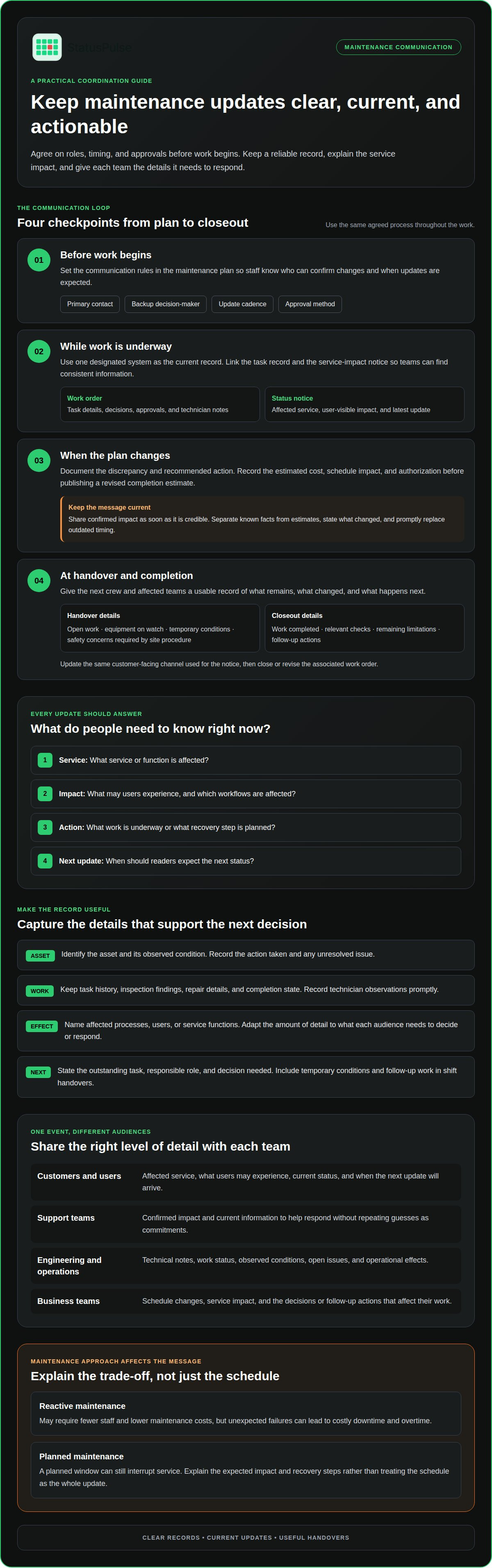
Use one designated system as the current record for maintenance status, decisions, and customer-facing updates. A work order can track the task, while a status notice explains the service impact. Link them so technicians and support teams can find consistent information. Keep technical notes, approval records, and public messages in the locations intended for each.
Before planned work begins, agree on a primary contact, a backup decision-maker, an update cadence, and an approval method. Record these in the maintenance plan so staff know who can confirm a schedule change. Supervisors should also review technician notes in the maintenance system and act on observations that affect the work.
The maintenance approach affects downtime and operating costs. Reactive maintenance may require fewer staff and lower maintenance costs, but unexpected failures can lead to costly downtime and overtime. A planned maintenance window can still interrupt service, so explain the expected impact and recovery steps rather than treating the schedule as the whole update.
Document approval whenever the maintenance scope changes. Record the discrepancy, recommended action, estimated cost, schedule impact, and authorization in the work order or approved record. For example, if an inspection reveals a new fault, note what changed and who approved the added work before publishing a revised completion estimate.
What accessibility and localization requirements apply to maintenance notices? Adapt language and format to the affected audience, including its cultural and linguistic context, as the Centers for Disease Control and Prevention (CDC) advises. A plain-language text alert may suit customers who need a quick summary of service impact; detailed technical notes can stay in the maintenance record.
How far in advance should planned maintenance be announced? Send the notice once the schedule, affected service, and expected impact are clear enough to explain. If the scope changes, promptly publish the new timing and identify what changed. Do not leave an outdated notice live.
How often should customers receive maintenance status updates? Set the cadence according to the event’s duration and customer impact, and state when the next update will arrive. Daily updates are often appropriate during heavy inspections, long-term projects, major avionics work, and AOG recovery.
What wording and tone should maintenance messages use? State the affected service, what users may experience, the action underway, and when the next update will arrive. Use direct language such as, “The API is unavailable during database maintenance; the next update will follow after the deployment check.”
How should businesses communicate unexpected maintenance or delays? Share the confirmed impact as soon as it is credible, then explain the cause, recovery plan, next decision point, and realistic revised timeline. Separate known facts from estimates so support teams do not repeat guesses as commitments.
What are best practices for communicating maintenance completion and service restoration? Confirm the work completed, relevant checks, any remaining limitations, and follow-up actions. Update the same customer-facing channel used for the maintenance notice, then close or revise the associated work order.
What are common maintenance communication mistakes and risks? Scattered records, unclear approval ownership, and outdated notices can leave teams acting on conflicting information. Keep emergency alerts distinct from routine updates, and review missed handoffs or repeat work to identify where the process failed.
2. Choosing what maintenance information to document
Capture information that helps the next person understand the asset, the work, and its operational effect. Technicians should record observations promptly, while details are still clear. “Pump vibrates during startup” gives operations more useful context than “pump checked.” Include the asset identifier, observed condition, action taken, and any unresolved issue.
Use a shift-handover template for details that may change between crews. Include open work, equipment on watch, temporary conditions, and safety concerns required by site procedure. For example, a temporary repair should state what was repaired, what limitation remains, and what follow-up task is pending. This makes the handover useful without duplicating the work order.
- Work history: Record the task, inspection findings, repair, and completion state.
- Current condition: Note abnormal readings, observed changes, and equipment placed on watch.
- Operational effect: Identify affected processes, users, or service functions.
- Next action: Name the outstanding task, responsible role, and decision needed.
Keep detailed records of maintenance activities, inspections, and repairs. They give maintenance managers a basis for reviewing recurring faults and planning routine work. Historical maintenance data, inventory usage, downtime incidents, and root-cause analyses can also inform future decisions. For predictive maintenance, retain relevant condition observations so teams can compare later findings with earlier asset behavior.
What information should a maintenance status page show? Include the affected service, current maintenance state, user-visible impact, and latest update. Give readers a clear next step, such as retrying a request after restoration, only when it is appropriate.
How should maintenance communications address service impact and affected users? Describe the functions that may be unavailable or slower, then identify the users or workflows affected. For example, explain that scheduled database work may interrupt report generation while account access remains available.
Separate internal technical detail from the customer-facing explanation. An engineer may need a component name and diagnostic note; a customer needs to know how the issue affects their task. A public status page can provide a concise service update, while the maintenance record preserves repair context and inspection details.
Review the template after completed work. Remove fields that no longer help technicians or decision-makers, and keep required safety information aligned with site procedure. A focused public status page can keep service-impact updates distinct from detailed maintenance records.
Remove steps that no longer help users create accurate records. Keep essential evidence: temporary repairs, deferred work, asset condition, and safety-relevant information required by site procedures. A structured shift-handover template should cover open work, equipment on watch, temporary conditions, and required safety concerns. This gives each crew a consistent way to carry forward unresolved matters while allowing for asset-specific detail. Preserve detailed maintenance, inspection, and repair records to inform decisions and support regulatory compliance. Review fields regularly with the people who use them, retaining what supports safe continuity, useful analysis, and accountable decisions.
3. Cross-department communication and collaboration
Maintenance decisions affect more than the team doing the repair. Production may adjust a shift, customer support may prepare for user questions, and finance may track operational impact. Set a coordination process that assigns each department a role, decision owner, and route for raising concerns. These best practices for maintenance mode communication connect maintenance decisions to the work other teams need to do.
Begin planning with the teams affected by the asset or service. Ask operations to identify dependencies, support to anticipate customer questions, and procurement to flag parts constraints. For example, a planned pump repair may require production to switch lines while procurement confirms replacement-part timing. These inputs help uncover conflicts before technicians begin.
Build a cross-functional playbook around decisions, not just message distribution. Define who assesses impact, who approves operational changes, and who informs affected teams. Review the playbook with each maintenance department to confirm the steps are workable. A process that depends on one manager’s approval can stall when that person is unavailable.
Use a shared check-in to surface questions before they lead to breakdowns or failures. Cover the asset’s current state, open dependencies, decisions due, and changes since the previous discussion. Tie each point to evidence, such as a technician’s observation or a production constraint. This gives departments a shared basis for action instead of relying on separate informal summaries.
- Operations: Confirm affected equipment, process dependencies, and workarounds.
- Maintenance: Explain findings, task constraints, and technical decisions needed.
- Support: Prepare a consistent explanation of customer-visible effects.
- Management: Resolve priority conflicts and authorize cross-team changes.
Organizations with multiple plants can hold quarterly or bi-annual meetings to review company-wide practices. Compare recurring faults, effective handoffs, and local constraints. A practice that works at one site may not suit another site’s equipment or operating model. Record the shared standard and any approved local variations.
Measure collaboration through outcomes, not meeting attendance. Track missed handoffs, repeat work, unresolved dependencies, and delayed decisions. If a department repeatedly learns about a changed work window late, trace the cause to unclear ownership, a missing review step, or an update sent through the wrong channel. This makes best practices for maintenance mode communication actionable rather than merely aspirational.
Close the loop with people who contributed observations. When a technician’s report leads to scheduled work, share the outcome with that technician and relevant operations staff. Review feedback after the work, then update the playbook when teams identify a practical improvement. Continuous participation is easier to sustain when contributors can see how their input shaped a decision.
4. Communication between maintenance and other departments
Maintenance updates should help each department make its next decision. Operations needs to know whether equipment or workflows will change. Customer support needs a clear explanation of user impact. Finance may need approved scope and schedule changes for tracking. Give each team the detail it needs while maintaining one shared record of current facts.
Match the communication pattern to the work. For a short, predictable task, an induction check-in, findings update, and completion notice may be enough. If an inspection changes the scope, tell affected teams what was found, what action is proposed, and whether the schedule or operational plan needs to change.
Raise delivery risks as soon as they become credible. The maintenance team should explain the cause, recovery plan, next decision point, and realistic revised timeline. For example, if a replacement part delays preventive maintenance, operations can adjust its sequence while support prepares an accurate customer response. Waiting until the original deadline passes leaves other teams little time to adapt.
- Routine work: Share the task window, expected effect, findings, and completion state.
- Schedule risk: State the cause, recovery action, decision required, and revised timing.
- Emergency: Use the designated alert route, then add a written record for tracking.
- Return to service: Confirm work completed, checks performed, limits, and follow-up actions.
Keep urgent alerts separate from routine maintenance messages. Radio can reach people monitoring a channel at once; a logged note may not be read immediately. Use the channel defined for the event, then document the decision and status in the system used for ongoing work. Facilities teams should train on emergency communication protocols and hold drills so people know the process before a critical failure.
Completion requires a useful handback, not just a “done” message. Confirm which work is finished, which major findings were addressed, and whether any recommendations remain deferred. Include relevant operational checks, limitations, or crew follow-up so the receiving department understands the asset’s condition. This prevents teams from treating a repair as a full return to service when conditions still apply.
Review missed handoffs, repeat work, and delayed decisions to see whether communication worked. These measures reveal gaps that message volume alone can hide. If a technician’s observation leads to scheduled work, tell the technician what happened. Regular feedback between maintenance and management can improve the strategy and keep department-level procedures practical.
Regular feedback and performance reviews can support ongoing dialogue between maintenance teams and management. When a technician’s logged observation leads to scheduled work, share the outcome to build trust in the recordkeeping system. Communication tools can cut the time needed to process facilities maintenance work orders in half; however, processing speed alone does not show whether communication is effective.
Check communication measures against outcomes such as missed handoffs or repeat work, and keep emergency alerts distinct from routine maintenance communications. Radio can reach everyone monitoring a channel at once, while a logged maintenance note may not be read immediately.
5. Company-wide maintenance practices and open communication
Company-wide maintenance works best when local work connects to organizational priorities. A repair may protect production continuity, customer commitments, or asset reliability. Make the connection explicit in planning: identify the business goal, the maintenance action that supports it, and the team responsible for reporting progress. This helps departments understand why a task is a priority.
For longer-range planning, a policy deployment matrix can align individual goals with company-wide goals. Set strategic goals three to five years in advance, then connect maintenance actions to them. For example, an asset reliability objective can guide which recurring failures teams investigate and which preventive tasks receive attention.
Choose measures that show whether maintenance practices support those objectives. Mean Time Between Failures and Mean Time to Repair reveal different aspects of asset performance. Review the measures weekly or monthly, and discuss what changed, why it changed, and what action follows. A KPI without an owner or response is just a record.
- Define the source: Identify whether each measure comes from work records, sensors, or performance-monitoring software.
- Set an owner: Assign a role to review the result and raise operational concerns.
- Connect to action: Record the decision, such as changing an inspection plan or investigating repeat failures.
- Share the outcome: Explain the decision to affected teams and include it in the relevant maintenance record.
Software can support consistent reporting, but it cannot replace shared operating rules. Explain why each system is used, how it supports the workflow, and where teams should record decisions. Then ask staff to demonstrate the process, such as locating an open task or documenting a completed inspection. A demonstration exposes unclear steps more effectively than an attendance record.
Training should connect system use to real maintenance scenarios. For example, technicians can practice recording a recurring fault while supervisors trace how that entry informs a work decision. If a software field prompts no useful action, remove or revise it. This keeps company-wide records focused on decisions rather than data collection for its own sake.
Open communication also means sharing problems and successes across sites. A team that resolves a recurring equipment issue can document the finding, corrective action, and conditions where the approach worked. Other departments can assess whether those conditions match their own operations before adopting the practice.
Make the public-facing update part of that communication system, not a substitute for internal coordination. A shared public maintenance update can give customers a consistent view while teams manage detailed decisions in their operational systems.
StatusPulse: Public Status Pages
StatusPulse provides Public Status Pages for sharing service updates with customers during maintenance or disruption. Use a public page to communicate the affected service, current impact, and restoration progress, while keeping detailed work records in internal systems. Uptime Monitoring, SSL Certificate Monitoring, and API Monitoring help teams track service and certificate availability as part of their operational picture. These tools support clear updates; teams still decide what to communicate and when.
If customers need a consistent place to find maintenance information, explore StatusPulse Public Status Pages. Visit StatusPulse to see whether its status pages fit your communication workflow.
Make the next maintenance window a test of your process
Before the next planned change, run a brief tabletop exercise based on a realistic failure scenario. Ask each team where it would find the current status, who can approve a revised plan, and what information it needs to act. This exposes gaps before a real interruption puts pressure on people and systems.
Then choose one improvement to implement. Clarify who owns the next update, define how teams record a scope change, or rehearse the handoff from maintenance to operations. Keep the change small enough to review after the next maintenance window. Use what teams learn to refine the process, not just the message.
Applying the best practices for maintenance mode communication is ongoing work: clear ownership and useful records need to hold up as systems and teams change. If you’re evaluating how to support customer-facing updates, contact StatusPulse to discuss communication.
Start with one practical change, then build a process your teams can use with confidence.
Frequently Asked Questions
What should a maintenance mode announcement include?
Include the planned start and end times with a clearly stated time zone. This prevents teams in different regions from interpreting the window differently. If work spans several days, distinguish the overall maintenance period from any shorter service interruptions. For example, state that maintenance runs overnight in UTC, while report exports may be unavailable only during a defined part of that window.
Which channels are best for maintenance notifications?
Choose channels based on how each audience expects to receive operational notices, and avoid sending every update to every user. A service owner may need detailed internal alerts, while customers may prefer a concise notice in a familiar channel. Review notification settings and audience groups before sending, so routine progress messages do not create unnecessary alerts for people who only need material changes.


