
On March 15, 2026, the industry standard for SSL certificate validity officially dropped to a maximum of 200 days. This shift makes manual tracking impossible and increases the frequency of potential outages for teams relying on automated issuers like Let’s Encrypt. You've likely dealt with the stress of a silent renewal failure or the frustration of noisy, expensive legacy monitors that trigger alert fatigue.
It's time to move past basic reminders. We'll show you how to implement automated SSL certificate expiration alerts using a multi-stage architecture with 30, 7, and 1-day buffers. This guide covers building a resilient monitoring strategy that prioritizes API-first verification and data sovereignty in EU or US regions. You'll learn to eliminate "Connection Not Private" errors and maintain trust through integrated status pages and precise, actionable alerting.
Key Takeaways
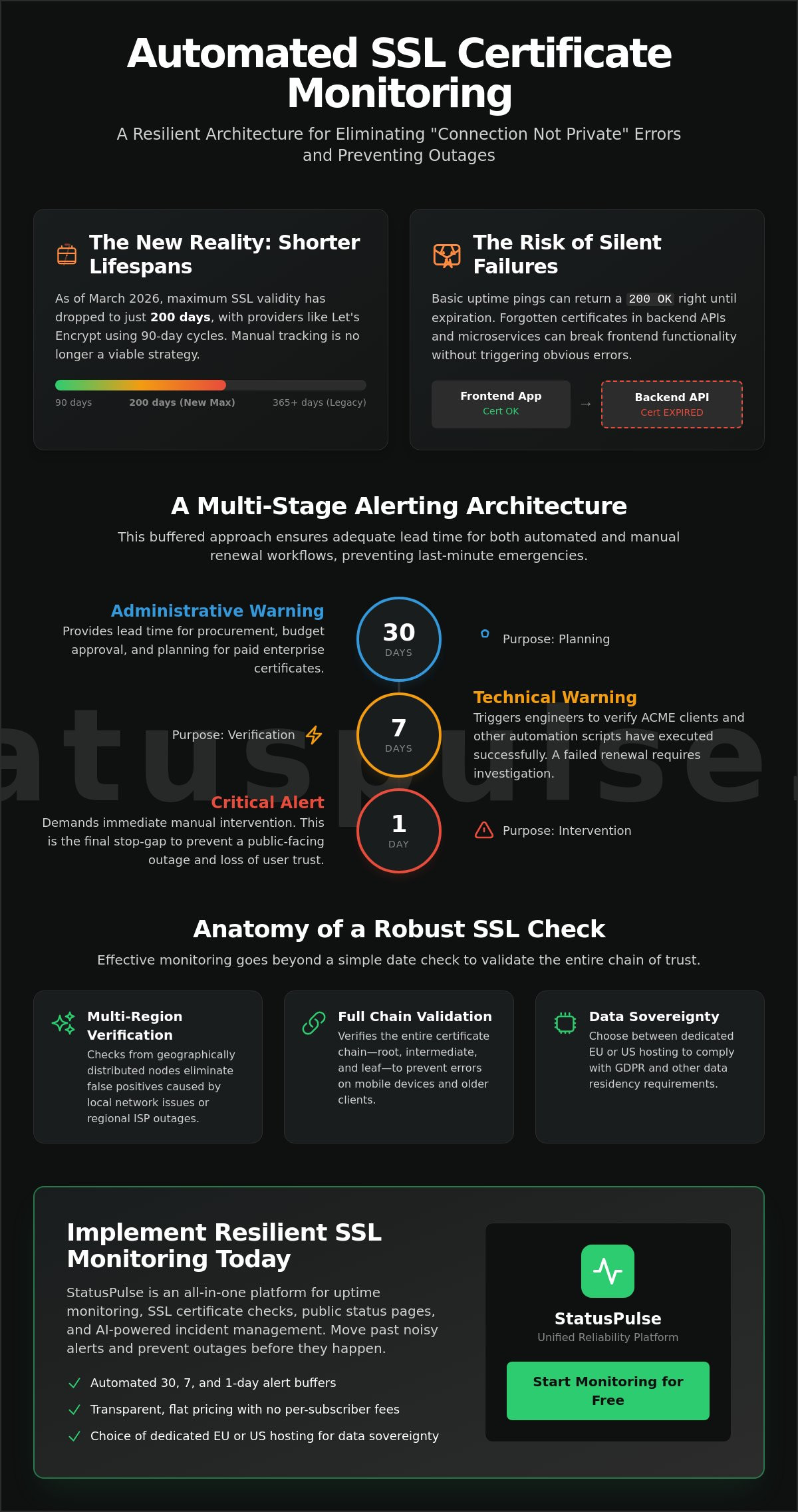
- Configure multi-stage alert buffers at 30, 7, and 1-day intervals to ensure your team has adequate lead time for both automated and manual renewals.
- Implement automated SSL certificate expiration alerts with multi-region verification to eliminate false positives caused by localized network disruptions.
- Identify and prevent silent SSL failures in microservices and machine-to-machine API communication that can break frontend functionality without triggering 404 errors.
- Reduce alert fatigue by utilizing AI-assisted incident summaries and human-centric monitoring strategies that prioritize critical security warnings over noise.
- Maintain data sovereignty and cost transparency by choosing monitoring tools that offer dedicated EU or US hosting and flat pricing models.
Defining Automated SSL Certificate Expiration Alerts
Automated SSL certificate expiration alerts are programmatic routines designed to query and validate the X.509 public key certificate presented by a server. Unlike manual reminders, these alerts function by establishing a TLS handshake to extract metadata directly from the endpoint. They provide a critical layer of defense for the chain of trust. This process ensures the cryptographic bond between a domain and its owner remains valid. Without this verification, web applications face immediate browser blocks and broken API connections.
There's a technical distinction between expiration alerting and Certificate Transparency (CT) monitoring. While CT logs help you identify certificates issued in your name by unauthorized parties, automated SSL certificate expiration alerts focus strictly on the operational lifecycle of your existing infrastructure. Standard uptime pings often fail here. A basic HTTP monitor might return a 200 OK status right up until the second a certificate expires. This leaves you with zero lead time to fix the issue before users see a security warning.
Why Manual Tracking Fails at Scale
Relying on a shared calendar or a spreadsheet creates a single point of failure. Human-managed systems can't keep up with the modern shift toward shorter certificate lifespans. As of March 2026, the industry has transitioned to a 200-day maximum validity period. Providers like Let's Encrypt maintain even shorter 90-day cycles. In microservices architectures, forgotten internal certificates can trigger cascading failures. One expired cert on a backend endpoint can bring down an entire user-facing application, even if the primary domain appears healthy.
The Anatomy of a Technical SSL Check
A robust check doesn't just look at a date. It uses tools like OpenSSL or specialized monitoring agents to retrieve the full certificate chain. The system parses the "Not After" field and compares it against UTC time to calculate the remaining time to live. Advanced checks also verify the issuing Certificate Authority (CA) and check for revocation via OCSP or CRL. For teams managing multiple endpoints, SSL certificate monitoring through a centralized platform ensures these checks happen consistently across all regions without manual intervention. This approach replaces human memory with reliable, repeatable logic.
The Architecture of a Reliable SSL Alerting System
A reliable architecture for automated SSL certificate expiration alerts must prioritize independence. If your monitoring agent resides on the same infrastructure as your web server, a local network failure or resource exhaustion could silence your alerts precisely when they are needed most. High-availability monitoring requires a geographically distributed approach. By verifying certificates from multiple global regions, you eliminate false positives caused by temporary routing issues or regional ISP outages.
Integrating these checks with your existing workflow is the next logical step. Push notifications to sinks like Slack, PagerDuty, or custom webhooks to ensure the right team receives the message. Effective systems also monitor domain registration alongside SSL validity. A valid certificate is useless if your domain expires and reverts to a registrar's parking page. This holistic view prevents blind spots in your external attack surface.
Multi-Stage Alert Buffers: 30, 7, and 1-Day Windows
Lead time is your best defense against downtime. Aligning with NIST Best Practices ensures you have a structured response plan. A 30-day alert serves an administrative purpose. It provides enough time for procurement or management to approve budget for paid certificates. This is often the longest part of the process in enterprise environments.
The 7-day alert is a technical warning. At this stage, engineers should verify that ACME clients or automation scripts have executed correctly. If the certificate hasn't renewed by this point, something in the automation pipeline has failed. Finally, the 24-hour alert triggers your high-priority incident protocols. This is a critical stop-gap that demands immediate manual intervention to prevent a public-facing outage.
Beyond Expiry: Validating the Certificate Chain
A certificate chain is the hierarchical list of Certificate Authorities ensuring trust between the root and your end-entity certificate. Monitoring just the expiry date of the leaf certificate is insufficient. Missing intermediate certificates often cause errors on mobile browsers even when desktop browsers appear to work fine. These browsers lack the extensive local trust stores found in OS-level environments and rely on the server to provide the full chain during the TLS handshake.
Modern monitoring should also flag protocol mismatches. If your server still supports TLS 1.0 or 1.1, or lacks support for TLS 1.3, it may fail compliance audits or be rejected by modern clients. Using a dedicated platform for SSL certificate monitoring allows you to track these technical nuances without managing your own complex probing infrastructure. This ensures you maintain a secure posture while focusing on your core application code.
Monitoring the Invisible: SSL in API and Microservices Environments
Silent failures are the most dangerous type of outage in modern architectures. When a user-facing certificate expires, the browser displays a clear warning. However, when a backend API certificate expires, the failure is often invisible to the end user. The frontend remains accessible, but requests fail in the background. This results in broken functionality without a single 404 error or server crash.
To mitigate this, automated SSL certificate expiration alerts must cover every endpoint in your stack. This includes microservices that communicate over private networks. Even if an endpoint isn't public, an expired certificate will break machine-to-machine communication. Monitoring private CAs and self-signed certificates in dev or staging environments is equally critical to prevent deployment surprises.
API Integrity and TLS Handshake Performance
Slow TLS handshakes consume your overall API response budget. If the cryptographic negotiation takes 500ms, your users feel that latency regardless of how fast your database queries are. Using API Monitoring helps you track these performance metrics over time. You can identify Server Name Indication (SNI) issues where the server serves the wrong certificate to the client.
These configuration errors often go unnoticed during manual testing. They occur when multiple certificates are hosted on a single IP address and the server defaults to the wrong one. Automated probes catch these mismatches by simulating various client handshakes. This level of SSL monitoring ensures that your security configuration doesn't become a performance bottleneck.
Automating Domain and TLS Health Lookups
Reliability requires correlating domain registration with certificate lifecycles. A domain expiring in ten days is just as critical as a certificate expiring tomorrow. You should also monitor Certificate Transparency logs. These logs help you detect if an unauthorized certificate has been issued for your domain, providing an early warning of a potential account compromise.
Deep TLS inspection provides better security but requires more compute resources. This is a trade-off you must accept for high-availability systems. It allows you to verify the entire chain and check for protocol downgrades. By automating these lookups, you remove the human element from the trust equation. This creates a more resilient infrastructure that survives beyond a single engineer's memory.
Solving Alert Fatigue: Human-Centric Incident Management
Alert fatigue is the psychological desensitization that occurs when engineers are bombarded by frequent, low-priority notifications. If automated SSL certificate expiration alerts trigger daily for two months before an expiry, they become background noise. This leads to a "boy who cried wolf" scenario. A critical 24-hour warning might be ignored because it looks exactly like the 60 pings that preceded it. Effective monitoring requires a hierarchy that respects an engineer's attention.
Trust is built on an independent source of truth. Your monitoring and status infrastructure must exist outside your primary stack. If your certificates fail and your status page is hosted on the same cluster, you lose the ability to communicate with your users. Maintaining a neutral, third-party observer ensures that even during a total infrastructure collapse, your "Source of Truth" remains reachable and reliable.
The Ethics of Transparent Incident Communication
Silence is the enemy of trust during a security-related outage. When a certificate expires, users don't just see a broken page; they see a warning that their data may not be safe. Drafting honest updates that explain the technical root cause without marketing fluff is essential. If an ACME challenge failed due to a DNS timeout, say so. This level of transparency shows professional integrity and reassures users that you've identified the specific failure point. For deeper insights into building this loop, see our guide on Uptime Monitoring and honest communication.
AI-Assisted Incident Drafting for Technical Teams
Incident response is a high-stress environment where every second counts. AI should not replace human judgment, but it can serve as a technical assistant to speed up communication. It can ingest raw certificate log data and draft a concise summary for your status page. For example, the system can parse a "Certificate Expired" error and automatically suggest a post explaining that the renewal script failed a validation check. This allows the engineer to focus on the fix while the AI handles the initial drafting.
A human-in-the-loop approach is mandatory for final verification. The engineer reviews the AI-generated draft, makes necessary technical corrections, and publishes. This ensures accuracy while significantly reducing the cognitive load during a crisis. Integrating automated SSL certificate expiration alerts with AI incident management helps your team stay calm and focused. You spend less time wrestling with status updates and more time restoring service for your users.
Implementing StatusPulse for SSL and Uptime Monitoring
StatusPulse provides a consolidated platform for monitoring and incident communication. It replaces fragmented tools with a single interface for uptime, APIs, and certificate health. Many legacy providers utilize complex pricing models based on the number of status page subscribers. We view per-subscriber fees as an ethical barrier to transparent communication. Our flat pricing model ensures you can inform your entire user base without financial penalty.
Integrating automated SSL certificate expiration alerts into your workflow shouldn't require managing your own probing infrastructure. StatusPulse handles the technical heavy lifting by querying your endpoints from multiple global regions. This approach provides the multi-stage lead time discussed earlier while maintaining a source of truth independent of your main application stack. It is a tool built by specialists who value precision over corporate bloat.
Why Data Sovereignty Matters in 2026
Data sovereignty is a critical requirement for modern technical teams, particularly those operating in regulated industries. You have the choice between hosting your monitoring data in the EU or the US. This flexibility helps you meet specific regulatory requirements and internal security policies. Regional hosting ensures that incident data and subscriber information stay within the correct jurisdiction.
Ensuring GDPR compliance for enterprise-grade SaaS platforms requires more than just a checkbox. It demands a commitment to privacy and data integrity. We avoid the data-harvesting practices common in larger enterprise suites. Instead, we focus on providing a reliable, straightforward service that respects your user's privacy and your team's time. This direct approach mirrors our preference for non-corporate communication.
Getting Started with StatusPulse
Setting up your first monitor is a straightforward technical task that takes less than five minutes. Enter your domain URL to begin the automated discovery process. The system retrieves the current certificate and allows you to configure the 30, 7, and 1-day alert buffers. You can then link this monitor to a public status page to display real-time SSL health to your users.
- Input your endpoint URL to start the discovery routine.
- Select your preferred notification sinks, such as Slack or PagerDuty.
- Enable AI-assisted incident drafting for faster, more accurate response times.
By centralizing your SSL certificate monitoring and status pages, you eliminate the silos that lead to missed renewals. You gain a resilient architecture that supports both technical verification and human communication. Build a more reliable monitoring system with StatusPulse.
Securing Your Infrastructure Against Silent Failures
Managing the trust lifecycle requires more than just a calendar reminder. By implementing automated SSL certificate expiration alerts with multi-stage buffers, you give your team the lead time necessary to handle both automated failures and administrative hurdles. Monitoring must extend deep into your microservices and API endpoints to prevent silent outages that bypass standard uptime checks. Reliability is built on these technical layers and maintained through honest, transparent communication with your users.
StatusPulse offers a principled alternative to corporate monitoring bloat. You get a unified platform for monitoring, status pages, and AI-driven incident management without per-subscriber fees. Whether you require EU or US hosting for data sovereignty, we provide the infrastructure to keep your services visible and your team focused. It's about moving from reactive fire-fighting to a proactive, resilient architecture. Start monitoring with StatusPulse to protect your uptime and preserve user trust.
Frequently Asked Questions
What is the difference between uptime monitoring and SSL certificate alerts?
Uptime monitoring checks if your server is reachable and returning a valid HTTP status code. SSL certificate alerts specifically query the cryptographic validity of the TLS handshake. A server can be "up" and running perfectly, but if the certificate is invalid, browsers will block access with a security warning. You need both to ensure your application remains fully accessible to users.
How far in advance should I set an SSL expiration alert?
A multi-stage approach is the most effective strategy. We recommend setting a 30-day alert for administrative tasks, a 7-day alert for technical verification, and a 24-hour critical alert for emergencies. Given the 200-day maximum validity period mandated in 2026, automated SSL certificate expiration alerts with these buffers provide the necessary lead time to fix renewal failures without rushing.
Can I monitor internal or self-signed certificates with StatusPulse?
StatusPulse monitors any endpoint reachable via the public internet, including those using self-signed certificates on staging or dev servers. Our probes will validate the "Not After" date regardless of the CA's trust status. If your certificates are strictly internal and not reachable from our global nodes, you'll need to use a localized monitoring agent instead. We prioritize external verification to mirror the real-world user experience.
Why did my site go down if my SSL certificate is still valid?
Site outages often occur even with a valid certificate due to secondary configuration issues. Common culprits include an expired domain registration, a missing intermediate certificate in the chain, or a protocol mismatch where the server lacks TLS 1.3 support. StatusPulse monitors these technical nuances to identify why a site is inaccessible even when the primary certificate date appears correct.
What is the "certificate chain" and why does it matter for monitoring?
The certificate chain is the hierarchical list of Certificate Authorities that links your certificate back to a trusted Root CA. If an intermediate certificate is missing from your server configuration, mobile browsers will often reject the connection. Monitoring the full chain ensures that your site remains trusted across all devices, not just desktop browsers with cached intermediate stores.
How do I prevent false positive SSL alerts?
Preventing false positives requires a multi-region verification strategy. StatusPulse probes your endpoints from multiple global locations simultaneously. If a certificate appears invalid from one region but fine from others, it's likely a localized network or routing issue. The system only triggers a critical alert when multiple regions confirm the failure, saving your team from unnecessary middle-of-the-night pages.
Does StatusPulse support Let’s Encrypt automation monitoring?
Yes, StatusPulse acts as an essential secondary check for Let’s Encrypt and other ACME-based automation. While these scripts are generally reliable, they can fail due to DNS timeouts, API rate limits, or server misconfigurations. Our monitoring detects when a renewal hasn't occurred as expected, providing a safety net for your automation pipeline before the short 90-day certificate window expires.
Why is EU hosting important for my monitoring data?
EU hosting is critical for teams that must adhere to strict data sovereignty and GDPR requirements. It ensures that your monitoring logs and subscriber data remain within European jurisdiction, meeting legal and security compliance standards. StatusPulse offers a choice between EU and US hosting to give you full control over where your technical data resides without defaulting to a single region.


