
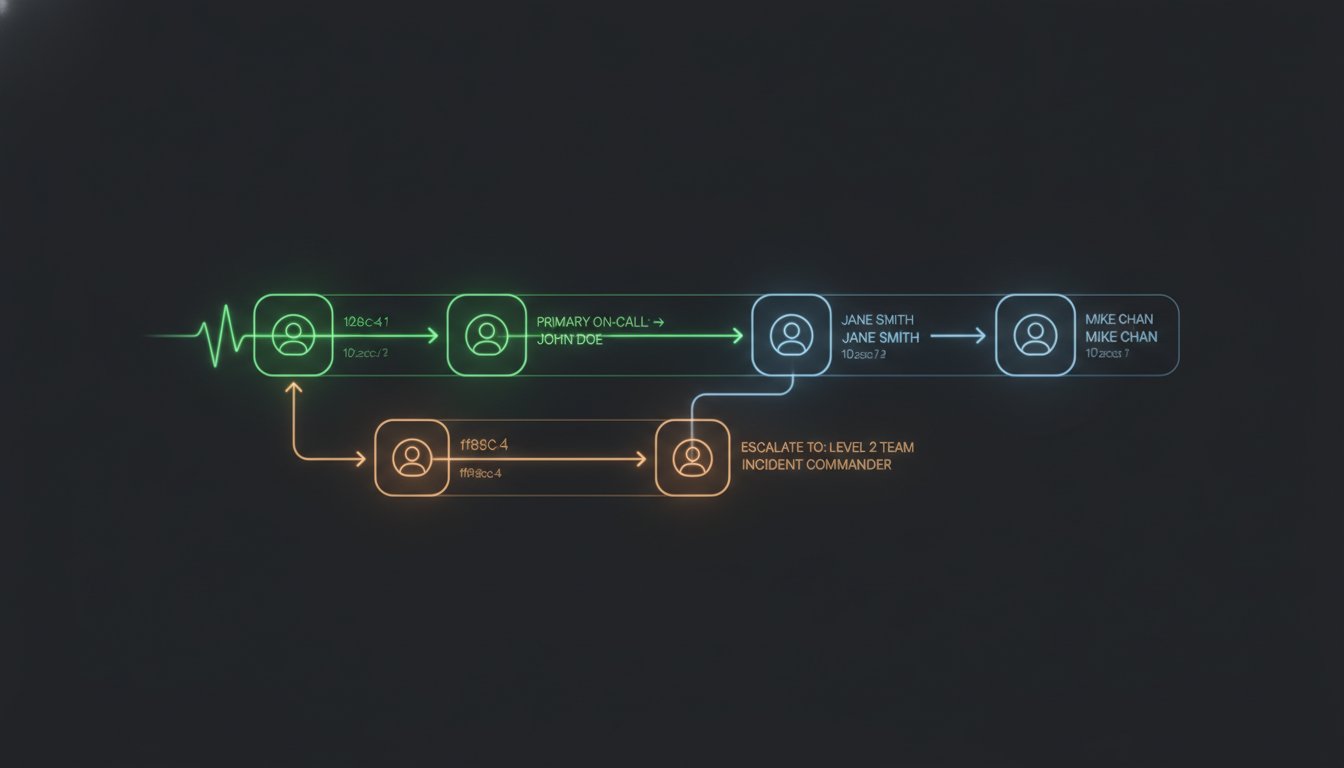
Why should adding a fifth engineer to your rotation trigger a massive increase in your monthly software bill? For many teams, the cost of coordinating a simple response is becoming more expensive than the downtime itself. We've been told that reliable On-Call Without the Enterprise Price Tag: Schedules and Escalation Policies and Multi-Channel Paging is a luxury feature reserved for those who can afford per-user pricing models that penalize growth.
It's a frustrating trade-off. You need robust schedules and alerts that bypass "Do Not Disturb" settings, but you don't need the corporate bloat or complex configurations. We agree that reliability shouldn't be a premium add-on. This article provides a clear framework for building professional on-call rotations with multi-channel logic that respects your budget. We'll look at configuring primary-secondary schedules, setting up escalation timeouts, and ensuring notifications reach the right person every time.
Key Takeaways
- Identify the hidden costs of per-user licensing and how to scale your engineering team without increasing your infrastructure overhead.
- Construct sustainable rotations using daily or weekly shifts that account for time zone offsets to prevent engineer burnout.
- Define clear escalation paths with specific acknowledgment timeouts to create a reliable fail-safe logic chain for every incident.
- Implement On-Call Without the Enterprise Price Tag: Schedules and Escalation Policies and Multi-Channel Paging to ensure urgent alerts bypass "Do Not Disturb" settings.
- Consolidate uptime monitoring and paging into a single workflow to remove the manual coordination overhead that slows down resolution times.
The Enterprise Tax on Reliability: Why On-Call Costs So Much
On-call infrastructure is more than a notification system. It's the critical logic layer sitting between a technical alert and a human responder. When an API endpoint fails at 3 AM, the system must instantly determine who is available, who has the right permissions, and which channel will actually wake them up. This process should be transparent and predictable. It's the difference between a resolved incident and a prolonged outage.
The problem starts with per-user pricing models. This "per-seat anxiety" forces managers to choose between team growth and budget constraints. If adding a new developer to the rotation costs an extra [VERIFY: PagerDuty entry price for 2026] every month, teams often keep their rotations too small. This leads to burnout and increases the risk of a missed alert. Reliability shouldn't be a luxury that scales linearly with your headcount.
Legacy software often carries "bloat" that adds zero value to your daily operations. You end up paying for complex "AIOps" features or machine learning modules that you never use. Achieving On-Call Without the Enterprise Price Tag: Schedules and Escalation Policies and Multi-Channel Paging requires stripping away these distractions. You need a system that focuses on the core mechanics of incident response without the hidden fees that usually accompany "enterprise" labels.
The Three Pillars of Modern On-Call
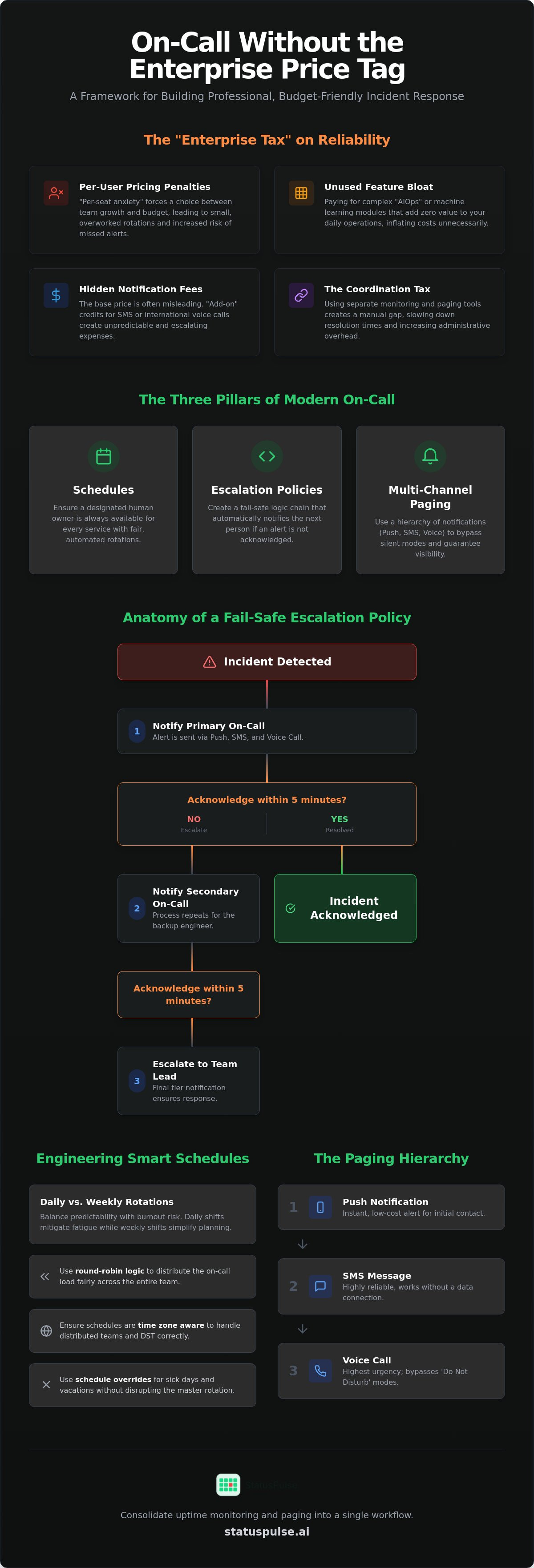
Effective incident management rests on three foundational elements. First, On-call scheduling ensures there's always a designated human owner for every service. Second, escalation policies serve as a fail-safe logic chain. If the primary responder doesn't acknowledge the alert within a set window, the system automatically moves to the next person. Third, multi-channel paging uses a hierarchy of push notifications, SMS, and voice calls to guarantee visibility, even when a phone is on silent.
Identifying the Enterprise Tax
The enterprise tax isn't always visible in the base price. It often hides in "add-on" notification credits for SMS or international calls. Some platforms also impose contract lock-ins that prevent you from switching tools as your stack evolves. Complexity is another hidden cost. When it takes hours to set up a simple weekly rotation, you're losing valuable engineering time to administrative toil. That's a tax on your productivity.
This focus on efficiency should extend to every part of a business; for example, agencies looking to scale their client acquisition in the restoration or HVAC sectors can learn more about LeadOpsIQ to see how lead intelligence can eliminate manual research toil.
By choosing a platform like StatusPulse, you get a unified view of your monitoring and incident response. This integration eliminates the "coordination tax" that happens when you have to bridge the gap between your monitoring tool and a separate paging service. You get professional-grade reliability with a cost structure that actually matches your usage and respects your engineering budget.
Engineering On-Call Schedules: Beyond Simple Rotations
A functional on-call rotation is more than a list of names on a spreadsheet. It is a commitment to service availability that balances technical needs with human limits. Achieving On-Call Without the Enterprise Price Tag: Schedules and Escalation Policies and Multi-Channel Paging requires a system that handles complex logic without requiring a dedicated administrator. You need to decide between daily and weekly shifts based on your team's specific alert volume and service complexity.
Weekly rotations are common because they offer predictability for personal planning. However, by day five of a high-intensity shift, burnout becomes a significant risk. Daily shifts can mitigate this but require more coordination during handoffs to ensure context isn't lost. Fairness is a technical requirement, not just a cultural one. Using sequential or round-robin logic ensures the load is distributed equally, preventing any single engineer from carrying a disproportionate burden of the "graveyard" shift.
Time zone awareness is another critical factor. For distributed teams, your management tool must handle UTC and local offsets correctly. If your system does not account for Daylight Savings transitions or regional holidays, you risk gaps in coverage. A well-defined on-call service policy provides the necessary guardrails, specifying exactly which systems are covered and what the expected response time is for every incident.
Handling the Unexpected with Overrides
Static schedules fail the moment an engineer gets sick or takes a vacation. Overrides allow you to implement temporary shift changes without breaking the underlying master logic. This keeps the primary rotation intact while ensuring the right person is paged. Automating the handoff notification ensures the next responder is actually ready to take over. If you are looking for a straightforward way to manage these logic layers, StatusPulse offers transparent scheduling that integrates directly with your monitoring.
Visualizing the Rotation
Visual clarity reduces team anxiety. A clear calendar view allows everyone to see who is currently active and who is up next. Integrating these schedules with tools like Google Calendar or Slack keeps the rotation visible in the places your team already works. For growing teams, "shadow" rotations are essential. They allow junior engineers to observe active incidents and response patterns without the pressure of being the primary responder, facilitating a smoother and safer onboarding process.
Designing Escalation Policies That Actually Work
An escalation policy is the fail-safe logic chain for incident ownership. It acts as a state machine for your technical alerts. If the primary responder does not move the incident to an "Acknowledged" state, the system must autonomously decide the next course of action. Implementing On-Call Without the Enterprise Price Tag: Schedules and Escalation Policies and Multi-Channel Paging allows you to define these rules without the configuration overhead of legacy enterprise suites.
The "Ack" or "Escalate" loop is the heartbeat of this policy. You must set realistic timeouts that balance response speed with human reality. For high-priority incidents, a 5-minute window is standard. For lower-priority issues, 15 minutes might be more appropriate. These timeouts prevent an alert from sitting unaddressed if an engineer is in a dead zone or misses the first notification. It transforms a single point of failure into a resilient chain of responsibility.
A tiered response moves the incident from the primary responder to a secondary backup or a manager. This ensures that ownership is always clear. If the entire chain fails to respond, a "dead-man switch" should trigger a final, high-urgency notification. This is your ultimate insurance against total system silence during a critical failure. It ensures that someone, somewhere, is aware of the service disruption.
The Anatomy of a Tiered Policy
A typical policy consists of three distinct levels. Level 1 targets the primary responder through low-friction channels like SMS or push notifications. Level 2 escalates to the secondary backup, often using a more intrusive automated phone call to ensure visibility. Level 3 is the final tier. This involves management or triggers an "all hands" page for critical failures that threaten your service level agreements (SLAs) or data integrity.
Avoiding Alert Fatigue
Paging every engineer simultaneously is not a strategy. It is a recipe for disaster. It destroys the sense of individual ownership and leads to alert fatigue. Grouping similar alerts is essential to prevent notification storms when a single root cause triggers dozens of downstream probes. By assigning incident priorities, you can ensure that only the most critical events trigger a full escalation path. StatusPulse provides the tools to group these alerts and manage your logic chains effectively, ensuring your team only wakes up when the situation truly requires human intervention.
Multi-Channel Paging: Bypassing Silent Modes Without the Bloat
A notification that isn't heard is just another log entry. Relying on a single channel like Slack or email creates a single point of failure. If your chat provider experiences an outage at the same time as your primary service, your team is effectively blind. True reliability requires a hierarchy of urgency. This approach ensures that On-Call Without the Enterprise Price Tag: Schedules and Escalation Policies and Multi-Channel Paging delivers the intrusive alerts necessary to resolve incidents before they impact your users.
The technical mechanism for bypassing silent modes relies on "Critical Alerts" for iOS and Android. These are high-priority push notifications that override system-level "Do Not Disturb" (DND) settings. While push notifications are fast, they can be dismissed or ignored during deep sleep. SMS acts as a reliable secondary layer. However, the automated phone call remains the most effective "wake-up" tool in your kit. It demands immediate human action in a way that text-based alerts simply cannot match.
Reliable notification systems are just as critical for physical site safety as they are for digital uptime; those interested in high-reliability communication for facility management can explore MyGatePass Security App to streamline coordination for security personnel and visitors.
Configuring Notification Rules
Effective paging follows a logical sequence. You should configure your rules to escalate the intrusiveness of the alert as time passes without an acknowledgment. This prevents over-notifying for quick fixes while ensuring the responder is eventually reached. A standard configuration includes:
- Immediate push: Send a critical alert the moment the incident is detected.
- Delayed SMS: If the alert isn't acknowledged within 2 minutes, send a text message.
- Final phone call: If silence persists at 5 minutes, trigger an automated voice call.
International Paging Reliability
Global SMS delivery is technically complex. Carriers often filter messages based on sender IDs or geographic origin. For EU-based teams, using a provider with localized infrastructure is vital to avoid these filtering traps. You need a partner that understands regional regulations and maintains high delivery rates across different borders. StatusPulse maintains [VERIFY: StatusPulse SMS delivery rates for EU regions] to ensure your alerts aren't blocked by carrier-level firewalls.
If you're tired of missed alerts and complex notification settings, you can set up multi-channel paging with StatusPulse to ensure your team is reachable on every channel without the enterprise bloat.
StatusPulse: Professional On-Call for Technical Teams
Reliability is a logic problem. We built StatusPulse to solve it without the per-user fees that inflate your monthly bill as your team grows. It is an all-in-one platform where uptime, SSL, and API monitoring trigger your rotations directly. This consolidation removes the coordination tax of managing separate monitoring and paging tools. It provides On-Call Without the Enterprise Price Tag: Schedules and Escalation Policies and Multi-Channel Paging by focusing on technical precision rather than corporate bloat.
We understand that data sovereignty is a requirement, not a feature. You can choose between EU or US hosting to meet your specific compliance standards or latency needs. When an incident occurs, our AI Incident Management tools generate automated summaries. This helps responders grasp the context of a failure quickly. It reduces the time spent on manual coordination during a crisis, allowing your engineers to focus entirely on the fix.
Built for Developers, Not Procurement Departments
You can set up your first rotation in minutes. Import your team, define your escalation logic, and connect your existing stack. We offer native integrations for Prometheus, Grafana, and custom webhooks to ensure your existing alerts flow directly into your schedules. It is a grounded approach to reliability. We don't use hype or marketing fluff. We provide the logic you need to keep your services running while respecting your engineering time.
The Ethics of Pricing
Pricing should be predictable and fair. We don't charge per subscriber or per seat because we don't believe in penalizing you for adding more engineers to your rotation. High availability is maintained through a focused, lean architecture. We avoid the enterprise bloat that often slows down legacy platforms. It's about honesty and technical integrity. You get the same robust multi-channel paging and escalation logic used by large organizations, but with a price structure that matches your actual usage.
Start building your on-call rotation with StatusPulse.
Building a Resilient On-Call Logic
Reliable incident management is a matter of technical precision. It shouldn't be a financial burden that grows with your headcount. By implementing structured rotations and tiered escalation paths, you create a fail-safe environment for your production services. You can achieve On-Call Without the Enterprise Price Tag: Schedules and Escalation Policies and Multi-Channel Paging by focusing on the core mechanics of reliability rather than corporate bloat.
StatusPulse provides a straightforward alternative to legacy incumbents. We offer transparent, flat pricing with no per-user fees to inflate your monthly bill. You maintain control over your data with EU or US hosting options while utilizing AI incident summaries to help responders act faster. It's about technical integrity and respecting your engineering budget. Get Started with StatusPulse for Free and build a rotation that fits your actual workflow. You have the tools to keep your services stable and your team rested.
Frequently Asked Questions
What is the difference between an on-call schedule and an escalation policy?
An on-call schedule defines who is responsible for a service at any given time. It is a calendar based rotation that manages shifts and handoffs. An escalation policy is the logic chain that dictates what happens when an alert is triggered. It ensures that if the person on the schedule does not respond, the incident moves to a secondary responder or manager.
Can I use StatusPulse for on-call without paying for per-user seats?
Yes. StatusPulse uses a flat pricing model that does not charge per subscriber or per seat. This allows you to add your entire engineering team to your rotations without increasing your monthly bill. It is a core part of our commitment to providing On-Call Without the Enterprise Price Tag: Schedules and Escalation Policies and Multi-Channel Paging.
How do multi-channel alerts bypass "Do Not Disturb" on mobile devices?
We utilize "Critical Alerts" entitlements on iOS and Android. These are high priority notifications that the mobile operating system allows to play sound even when the phone is muted or in a focus mode. For maximum reliability, we also use automated voice calls, which are more intrusive than standard push notifications and highly effective at waking up responders.
Does StatusPulse support international SMS and phone call paging?
StatusPulse supports global delivery for both SMS and automated voice calls. We use a distributed infrastructure to ensure that alerts reach responders across different geographic regions and carriers. For teams based in Europe, our localized delivery paths help avoid the sender ID filtering that often blocks international messages from US based providers.
Can I set up a secondary on-call person in case the primary responder is busy?
Tiered escalation is a standard feature in our platform. You can define multiple levels within an escalation policy, such as a primary responder (L1) and a secondary backup (L2). If the primary responder fails to acknowledge the incident within your specified timeout window, the system automatically pages the next person in the chain.
How does the AI incident management feature assist during an on-call shift?
The AI feature automatically generates summaries and timelines of the incident as it unfolds. This helps responders quickly understand the context of a failure without manually digging through logs or probe results. By providing a clear picture of the situation immediately, it reduces the cognitive load on engineers during high pressure shifts.
Is my data stored in the EU or the US?
You have the choice of where your data is hosted. StatusPulse offers both EU based and US based hosting options to support your specific data sovereignty and regulatory requirements. This ensures that European teams can maintain strict compliance with GDPR while benefiting from low latency monitoring and paging infrastructure.
What happens if an incident is not acknowledged within the escalation timeout?
If the timeout expires without an acknowledgment, the system triggers the next step in your escalation policy. This usually involves paging the secondary responder or a technical lead. If the entire chain fails to respond, you can configure a "dead man switch" to alert management or trigger an all hands notification to ensure the incident is addressed.


